

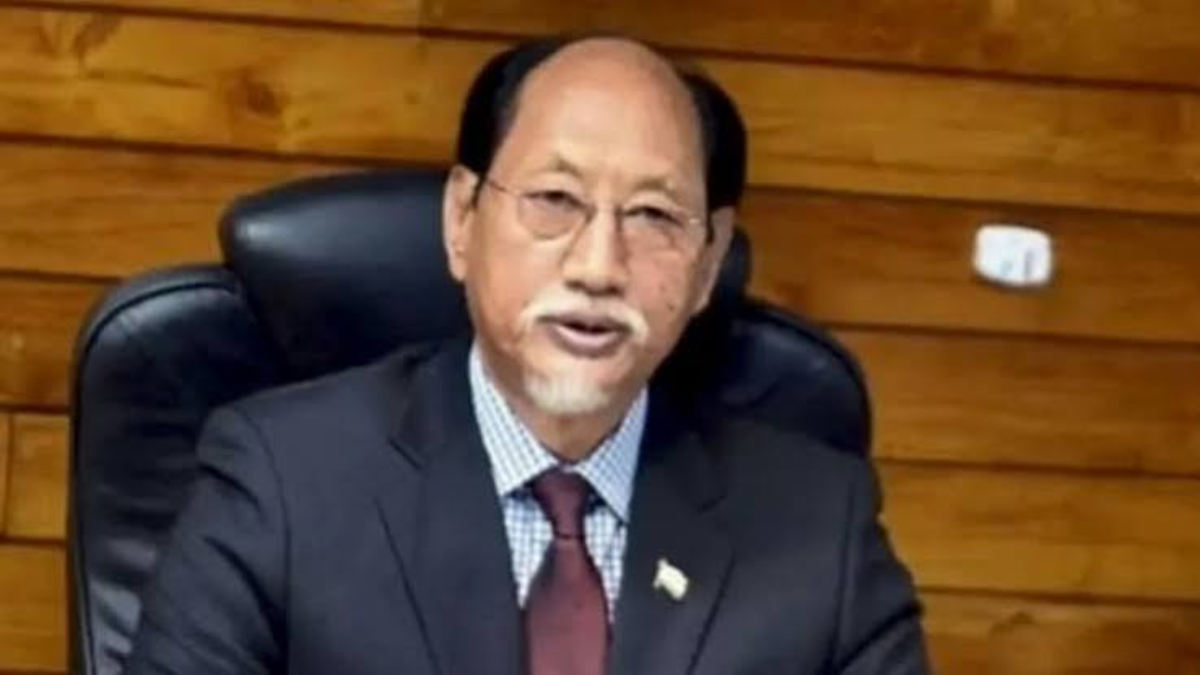
Naga peace talks remain stalled as Nagaland Chief Minister Neiphiu Rio and leaders of the National Socialist Council of Nagaland-Isak Muivah (NSCN-IM) discussed the reasons behind the delay and the proposed formation of an apex committee. The consultation took place on September 16 at the Police Complex in Chümoukedima and focused on creating a mechanism to help move the long-running political dialogue forward.
Rio outlines next step for Naga peace talks
The meeting brought together the Political Affairs Committee (PAC) of the Nagaland Legislative Assembly, led by Rio, and senior NSCN-IM representatives. After the closed-door consultation, Rio said the participants examined why the political negotiations had been delayed.
He also said the proposed constitution of an apex committee remained under discussion. According to Rio, the talks would resume after the committee is finalised. The Chief Minister did not provide details about the proposed panel’s membership or its precise structure.
The proposed committee therefore remains an important part of the immediate process. Its formation is still being negotiated, and the latest meeting did not announce a fresh agreement on the broader political settlement.
NSCN-IM calls meeting a consultation
NSCN-IM Member of Collective Leadership Rh Raising described the Chümoukedima interaction as a consultation rather than a formal negotiation. He said there were no specific outcomes to announce from the meeting.
When asked about the prospects of the political dialogue, Raising said the next step depended on the other side and indicated that the responsibility for advancing the process rested with the Government of India.
The distinction between consultation and negotiation is significant because the latest meeting did not itself reopen formal negotiations. Instead, it addressed the conditions and institutional mechanism required for the process to move ahead.
Why the Naga dialogue remains unresolved
The current delay comes after decades of negotiations between Naga political groups and the Centre. The NSCN-IM entered into a ceasefire agreement with the Government of India in 1997. In August 2015, the two sides signed the Framework Agreement, which was presented as a major step in the political dialogue.
However, several substantive issues remain unresolved. The NSCN-IM has continued to press demands concerning a separate Naga flag and constitution, as well as the integration of Naga-inhabited areas. These issues have remained central to disagreements over a final settlement.
The Centre has also been involved in parallel discussions with other Naga National Political Groups (NNPGs). The presence of multiple negotiating groups has made questions of representation and coordination an important part of the wider peace process.
Rio had sought a ministerial-level interlocutor
The latest consultation follows renewed efforts by the Nagaland government to secure a political mechanism for the dialogue. In August, the PAC, chaired by Rio, renewed its demand for a ministerial-level interlocutor to help advance the peace process.
The committee also planned consultations with stakeholders as part of efforts to develop a roadmap towards an early political settlement. The move followed earlier PAC discussions held in 2024 and 2025.
Rio had also recently said that the talks were stalled while expressing hope that the process could resume following Union Home Minister Amit Shah’s assurance that a Union Minister of State for Home Affairs would be appointed as interlocutor.
NSCN-IM distances itself from SC Jamir remarks
The Chümoukedima consultation also came amid a fresh public debate over who can speak on the Naga political issue. Former Nagaland chief minister and governor SC Jamir recently met RSS chief Mohan Bhagwat in Delhi, where the Naga issue was reportedly discussed.
NSCN-IM leaders rejected any suggestion that Jamir represented the Naga negotiating side. Raising said Jamir was not authorised to speak on the political issue, while NSCN-IM Deputy Ato Kilonser VS Atem similarly said people without a mandate could not represent the Naga political negotiations.
Rio declined to comment on Jamir’s remarks, saying the Naga People’s Front had already issued a statement on the matter.
The Nagaland government’s PAC is also expected to consult other Naga political groups as part of its broader engagement with stakeholders. That process could become relevant as discussions continue over representation and a common pathway towards a political settlement.
For now, the proposed apex committee remains the immediate procedural issue. Rio’s latest remarks indicate that formal negotiations are expected to resume only after its structure is settled, while the NSCN-IM continues to emphasise the role of the Centre in moving the process forward. The coming consultations are therefore likely to shape how the long-running dialogue proceeds and how different Naga groups participate in the next phase.
Joi Barua NASA Project Makes a Powerful Leap From Assam to Space