

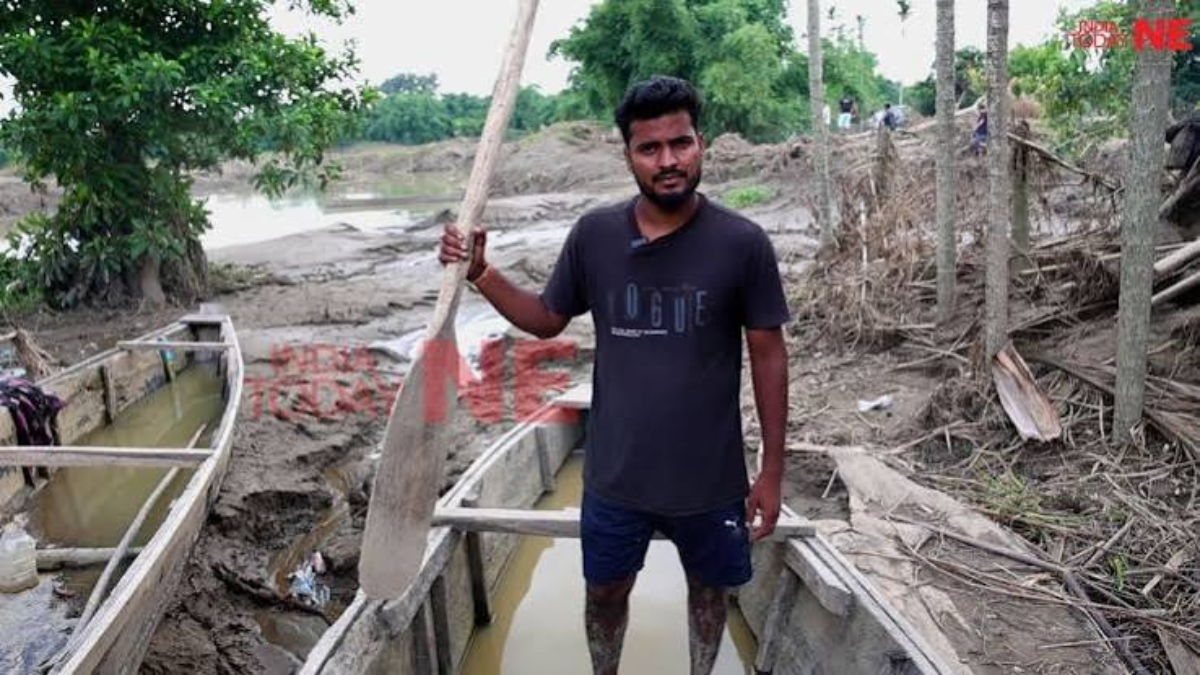
Shravan Prasad faced an impossible choice when floodwaters from the Dikhow river swept into Nepali Khuti village in Assam’s Sivasagar district on July 19. With his younger brother trapped inside their home and around 200 people stranded on rooftops, the 26-year-old had to decide where to take his only available boat first. He chose the villagers, knowing that delaying their rescue could cost lives.
Shravan Prasad and the sudden rise of the Dikhow
Nepali Khuti, located in Bihubor’s Quarry No. 2 area, had experienced monsoon flooding before. But the scale and speed of the July 19 flood caught residents off guard.
Shravan Prasad said he had gone to the Dikhow river with friends at around 3 am to collect floating timber used for cooking. Although the rain had been heavy and the river current was strong, there was no immediate indication that the village was about to be overwhelmed.
That changed by late morning.
According to his account, the water began rising rapidly around 10.30 or 11 am and entered the village before residents could fully understand the danger. He rushed home and first moved his parents and youngest brother, Prince, to safer ground. His other younger brother, Samir, remained at the family home.
A brother trapped as the floodwaters rose
Shravan told Samir that he would return after taking their parents to safety. But the rapidly rising water soon cut off the route between the houses.
Samir began calling repeatedly. He called 27 times as the floodwater rose around him and eventually reached his neck.
At the same time, Shravan Prasad was about half a kilometre away with a boat. Around 200 people were stranded on rooftops, with little room left to escape as the flood continued rising.
That was when the rescue effort became a deeply personal dilemma.
“I said, if I come for you, those two hundred people will die. I have to go to them first,” Shravan recalled.
He asked Samir to find higher ground and hold on. Then he left to help the stranded villagers.
Shravan Prasad turns one boat into a rescue mission
The first rescue trips were carried out by Shravan and a friend. Soon, more volunteers joined.
One friend brought two more people, who brought others. Within hours, a small group of local boatmen had formed a rescue team. By evening, nearly a dozen men were moving through the flooded village, navigating submerged roads and homes.
Shravan Prasad and the volunteers pulled people from rooftops and carried those who were elderly, sick or unable to move on their own to safer ground.
The conditions were extremely difficult. Water rose to the shoulders of some rescuers, while heavy rain continued and official rescue teams were unable to reach the isolated village at the height of the crisis.
“We had only ourselves,” Shravan said.
By the time the waters settled, Shravan and his fellow volunteers had helped more than 1,000 people reach safety. Samir also managed to escape on his own.
A flood rescue remembered by Nepali Khuti
For Shravan, the rescue was not about recognition. He said he was not thinking about his own safety but about how many people he could still save.
One incident has stayed particularly strongly with him. An elderly man and four family members were stranded on a tin roof as the water rose around them. After the rescue, the man told Shravan that he had feared it would be his family’s final moment together.
The experience reflects the wider devastation caused by the floods in Assam. Hiloni Nepali Khuti, also in Sivasagar district, was previously reported to have been almost completely wiped out by the Dikhow, with around 200 Gorkha families losing homes and property.
Relief operations have continued across Upper Assam, with volunteers, social organisations and government agencies providing food, drinking water and other essential supplies to affected communities.
The broader flood crisis has remained severe. As of August 8, Assam’s flood death toll had risen to 98, while around 1.55 lakh people across 13 districts remained affected, according to an official bulletin. Authorities have also announced a door-to-door assessment to identify losses and reach affected families.
For Nepali Khuti, however, the disaster is also remembered through the actions of ordinary residents who stepped forward when formal help could not immediately reach them.
Shravan Prasad faced a decision no one should have to make: return for his brother or continue rescuing hundreds of neighbours. He chose the larger group, believing lives depended on it. His brother survived, and the rescue effort eventually brought more than 1,000 people to safety. But the moment when he told Samir that he could not come remains one of the most haunting accounts to emerge from Assam’s devastating floods.
Assam Flood Relief Fundraiser Row: Himanta’s Strong Response to Overseas Donation Drive