

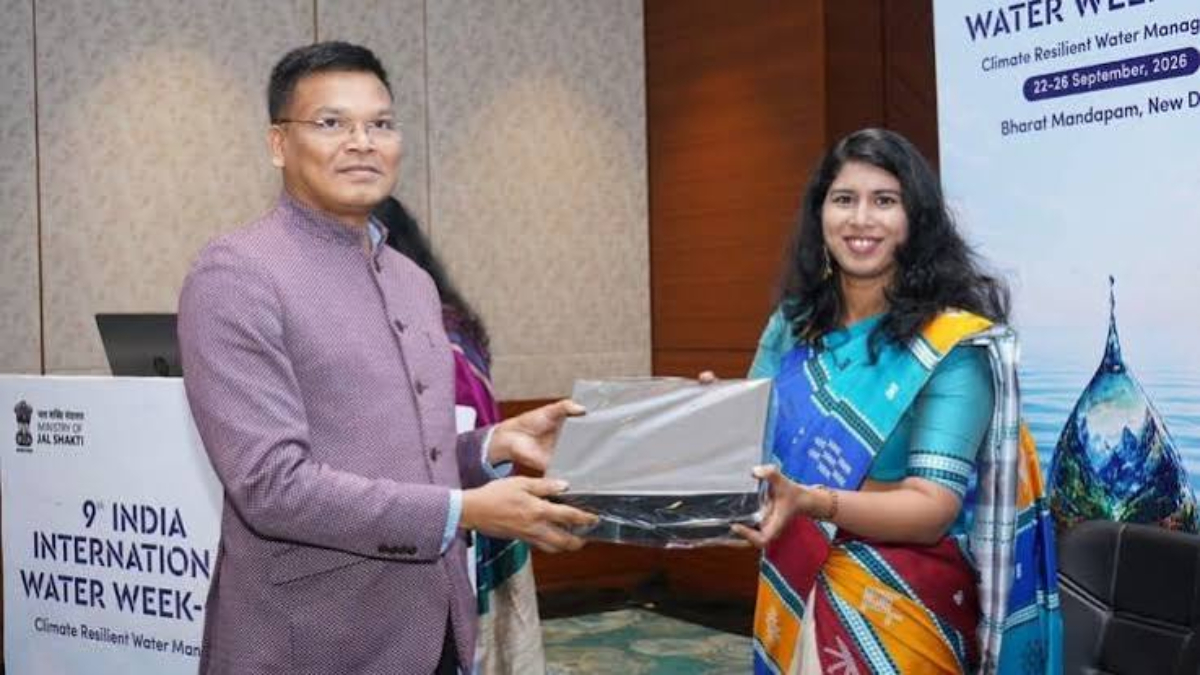
North Tripura water conservation initiatives received national and international attention at the 9th India International Water Week (IIWW) 2026 in New Delhi, where the district administration presented community-led models for protecting and managing water resources.
North Tripura District Magistrate and Collector Chandni Chandran participated as a speaker at the Practitioners’ Forum on Best Practices at Bharat Mandapam on September 24. She highlighted three initiatives from the district — the Uttar Jal Sanchay Yatra, rainwater harvesting saturation in Vanghmun and springshed management in Jampui and Damcherra blocks.
The presentation came as IIWW 2026 brought policymakers, researchers, development organisations and water-sector stakeholders together around the theme of “Climate Resilient Water Management”. The event is being held from September 22 to 26 at Bharat Mandapam and is organised by the Ministry of Jal Shakti.
North Tripura water conservation model focuses on local participation
The Uttar Jal Sanchay Yatra was presented as a district administration-led initiative designed to strengthen awareness and participation around water conservation. Rather than relying only on infrastructure, the approach places local communities at the centre of efforts to protect water resources.
The district’s presentation stressed the importance of cooperation between government agencies, communities and private-sector or development partners. Such convergence is increasingly important in areas where water sources depend on local geography, rainfall patterns and community management.
The initiatives also reflect a wider focus on making water conservation a sustained local practice rather than a short-term campaign.
Vanghmun demonstrates the value of rainwater harvesting
One of the key examples presented at the forum was Vanghmun in the Jampui Hills, where rainwater harvesting has been expanded through community participation.
A government publication earlier highlighted Vanghmun as a village that achieved 100 per cent rooftop rainwater harvesting coverage. Before the structures were installed, residents reportedly had to travel 4–5 kilometres to collect water from local water bodies. The campaign involved household surveys, awareness drives and regular village meetings before all households were covered by July 2025.
The experience offers an example of how household-level infrastructure and community mobilisation can work together to improve water availability.
Springshed management strengthens water security in hill areas
Another important component of North Tripura water conservation is springshed management in Jampui and Damcherra blocks. The initiative is being implemented with the Centre for Microfinance and Livelihood (CML), an associate organisation of Tata Trusts.
The programme focuses on protecting and rejuvenating spring-based water sources in the hilly areas, where communities can depend heavily on springs for drinking water and other daily needs. Tata Trusts says its water security and quality programme covers Dhalai, North Tripura and Jampui Hills, with more than 10,000 households expected to benefit across its Tripura and Assam programme areas.
The importance of springshed work is illustrated by projects in Jampui Hills. In one case, interventions included mapping a recharge area, treating part of the recharge zone and constructing staggered contour trenches to help rainwater infiltrate the hillside. A Spring Water User Committee was also formed to support long-term monitoring and maintenance.
Earlier work adds to the district’s water strategy
The district’s participation at IIWW follows earlier discussions on sustainable water management. In June, Chandni Chandran highlighted springshed management in Jampui Hills during a regional workshop in Guwahati and called for stronger conservation policies across the Himalayan and Northeastern regions.
Government data also shows continuing water-harvesting activity in North Tripura. Under the Watershed Development Component of the Pradhan Mantri Krishi Sinchayee Yojana, 39 water-harvesting structures were reported as constructed or revived in the district during 2025-26.
The district’s water-management efforts are also relevant to wider concerns about sustainable drinking-water access, groundwater recharge and climate resilience. Current water-sector discussions increasingly emphasise combining infrastructure with source sustainability and community ownership.
North Tripura’s presentation at IIWW 2026 therefore puts a local experience into a broader national discussion. Its examples show how administrative programmes, household rainwater harvesting, spring restoration and community institutions can be brought together to address water-security challenges. The district’s participation also gives greater visibility to community-based approaches that can potentially inform water-management efforts in other hilly and water-stressed regions.
Rima Das Busan Film Festival Jury Role Marks Major Milestone
[…] North Tripura water conservation gets major boost at India Water Week 2026 […]
[…] North Tripura water conservation gets major boost at India Water Week 2026 […]
[…] North Tripura water conservation gets major boost at India Water Week 2026 […]
[…] North Tripura water conservation gets major boost at India Water Week 2026 […]
[…] North Tripura water conservation gets major boost at India Water Week 2026 […]
[…] North Tripura water conservation gets major boost at India Water Week 2026 […]