

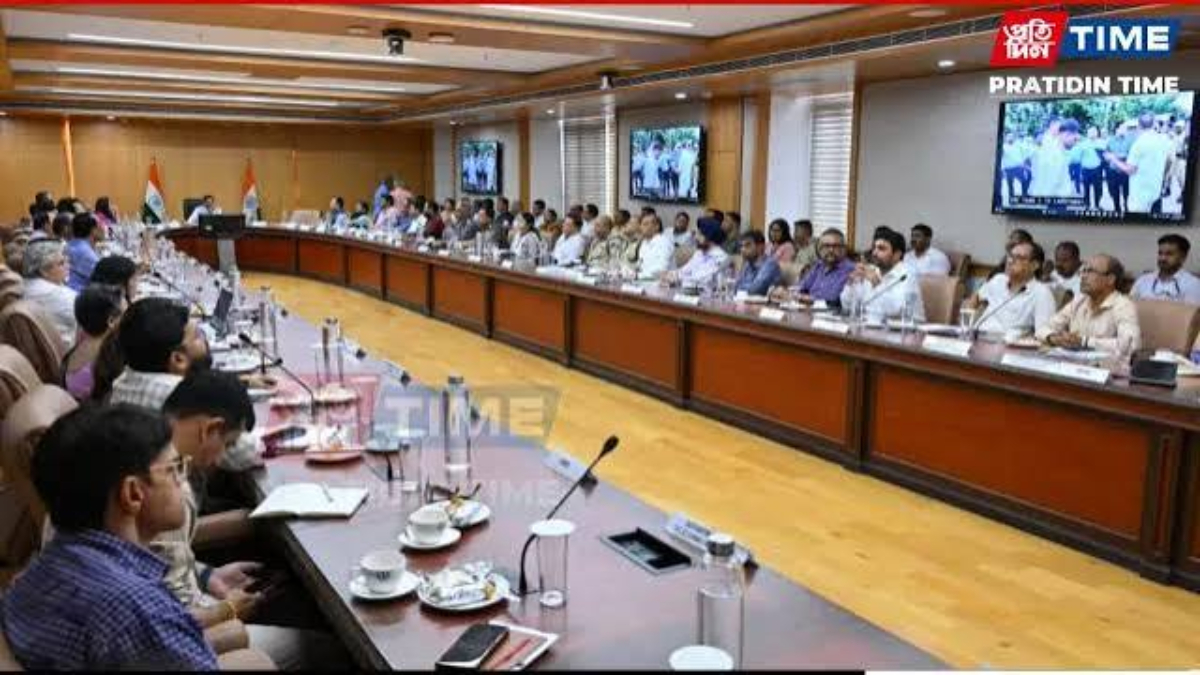
Assam flood assessment has entered a crucial phase after a central inter-ministerial team completed its visit to the flood-affected districts and held a detailed review meeting with the state’s Chief Secretary. The assessment is expected to help the Centre evaluate the extent of damage caused by the devastating floods and determine financial assistance for relief, restoration, and reconstruction efforts.
The multi-day visit allowed the central delegation to inspect affected areas, interact with district officials, and assess losses across sectors, including agriculture, roads, bridges, public infrastructure, and housing. The findings will now be compiled into a report for submission to the Union government.
Assam flood assessment reaches a key milestone
The Assam flood assessment concluded with a high-level review meeting chaired by Chief Secretary Ravi Kota. During the meeting, senior state government officials briefed the visiting central team on the widespread destruction caused by this year’s floods and the measures taken to support affected communities.
The delegation reviewed reports submitted by various departments covering damage to roads, embankments, irrigation facilities, educational institutions, healthcare centres, power infrastructure, and rural assets. Officials also presented updates on relief distribution, rehabilitation efforts, and ongoing restoration projects.
The assessment forms part of the Centre’s established procedure for evaluating natural disaster-related losses before considering financial support under the State Disaster Response Fund (SDRF) and National Disaster Response Fund (NDRF) norms.
Extensive field inspections across flood-hit districts
Before the review meeting, the central team visited several of Assam’s worst-affected districts. Members inspected breached embankments, submerged villages, damaged agricultural fields, washed-away roads, and public infrastructure impacted by prolonged flooding.
District administrations explained the challenges faced during rescue operations and highlighted the urgent need for strengthening embankments, improving drainage systems, and enhancing disaster preparedness.
Officials also informed the team that restoration work has already begun in several locations, although permanent reconstruction will require substantial financial resources.
Agriculture among the worst-hit sectors
Agriculture emerged as one of the sectors that suffered significant losses during the floods. Thousands of hectares of cropland were submerged, affecting paddy cultivation and other seasonal crops.
State officials informed the delegation about the economic impact on farmers and sought adequate financial support for crop loss compensation and agricultural recovery measures. Damage to fisheries, livestock, and horticulture was also highlighted during the review.
The visiting team examined reports prepared by the Agriculture Department while interacting with local authorities responsible for documenting losses.
Infrastructure damage highlighted during review
Another major focus of the Assam flood assessment was the destruction of public infrastructure.
Officials presented detailed estimates regarding damaged roads, bridges, culverts, irrigation canals, schools, healthcare facilities, drinking water systems, and electricity networks. Several embankments suffered breaches, leading to repeated flooding in vulnerable regions.
The Chief Secretary emphasized the importance of rebuilding critical infrastructure with improved resilience to withstand future flood events. Departments also shared proposals for long-term mitigation projects aimed at reducing recurring flood damage.
Relief and rehabilitation efforts discussed
The review meeting also covered the extensive relief measures undertaken by the Assam government during the disaster.
Authorities informed the central delegation about the establishment of relief camps, distribution of food, drinking water, medicines, and essential supplies to affected families. Special attention was given to vulnerable groups, including children, elderly residents, and pregnant women.
Officials noted that restoration of public services has progressed steadily following the receding floodwaters, although several areas continue to require rehabilitation support.
The central team appreciated the coordination between district administrations, disaster management authorities, and emergency response agencies throughout the crisis.
Report to guide Central assistance
The observations made during the Assam flood assessment will now be incorporated into a comprehensive report for submission to the Ministry of Home Affairs and other concerned departments of the Union government.
The report will evaluate sector-wise damage and verify the state’s claims regarding losses. Based on these findings, the Centre will consider the release of additional financial assistance in accordance with existing disaster relief guidelines.
Officials stated that the assessment is an important step in ensuring timely support for rebuilding damaged infrastructure and restoring livelihoods across affected districts.
Importance of scientific flood management
The review also reinforced the need for long-term flood management strategies in Assam, a state that experiences annual flooding due to heavy monsoon rainfall and the overflowing Brahmaputra and its tributaries.
Experts have consistently advocated stronger embankments, improved river management, advanced flood forecasting systems, better drainage infrastructure, and community-based disaster preparedness programmes.
The state government reiterated its commitment to working closely with the Centre to implement sustainable flood mitigation measures while improving resilience against future disasters.
The completion of the central team’s visit marks an important development in Assam’s recovery process. As the assessment report moves to the next stage, affected communities hope that adequate financial assistance will be sanctioned promptly to accelerate reconstruction, strengthen infrastructure, and support long-term resilience against recurring floods.