

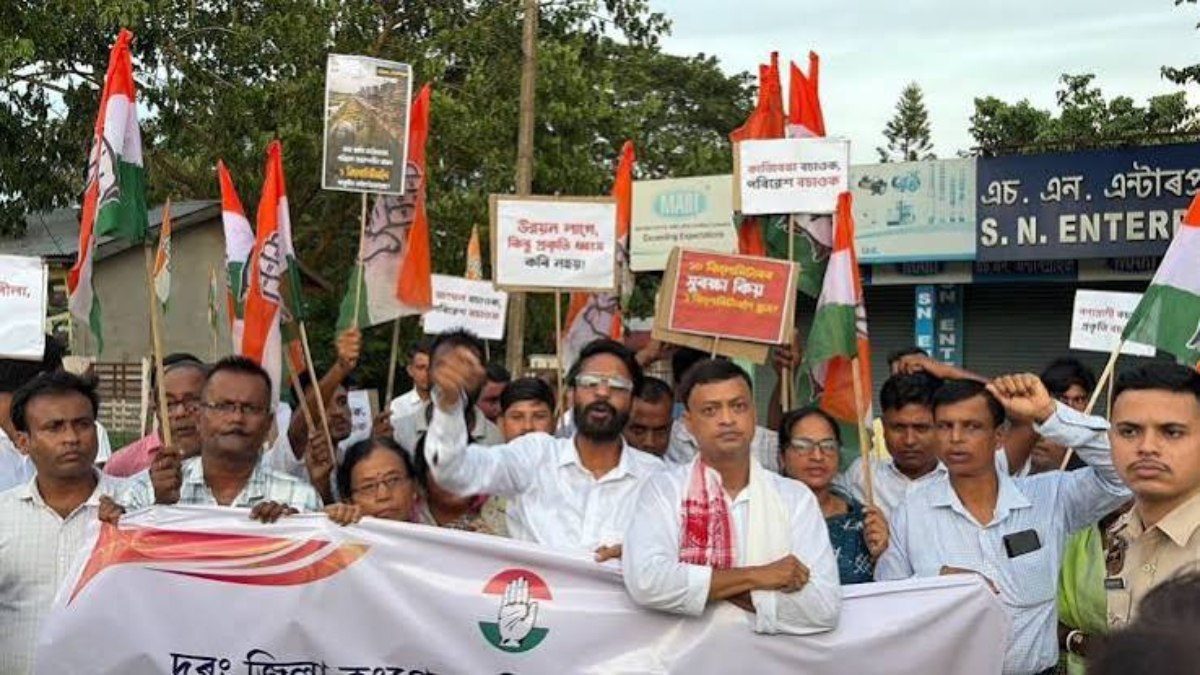
Kaziranga ESZ reduction has triggered a statewide political confrontation in Assam, with the Congress staging padayatras across several districts on August 29 to oppose the proposed change around Kaziranga National Park. The party has demanded that the Assam government withdraw its plan to reduce the Eco-Sensitive Zone (ESZ), warning that a narrower buffer could affect wildlife, biodiversity and the ecological security of the UNESCO World Heritage Site.
Congress takes protest to districts
The Assam Pradesh Congress Committee organised demonstrations in several parts of the state, including Sonitpur, Lakhimpur, Hailakandi, Karimganj, Tinsukia, Karbi Anglong and Golaghat. Party workers marched through district headquarters and raised slogans against the proposed change.
In Guwahati, Leader of Opposition in the Assam Assembly Wazed Ali Choudhury, former MP Ripun Bora, state women’s wing president Mira Borthakur and other Congress leaders participated in the protest. Police stopped protesters from leaving the Congress office in Dispur, after which some party workers attempted to cross the barricades and proceed onto the streets.
The Congress has said the protests will continue until the government reverses its position. Party leaders have also sought to build wider public awareness around the ecological implications of changing the protected zone.
Why Kaziranga ESZ reduction is controversial
The dispute centres on the Assam government’s plan to approach the Centre with a proposal to reduce the ESZ around Kaziranga. The default buffer is 10 km, while the state has proposed a site-specific range of between 1 km and 3 km.
An ESZ acts as a protective buffer around ecologically important protected areas. Activities within such zones are prohibited, regulated or permitted according to prescribed rules. The government has argued that the existing restrictions are creating difficulties for development and infrastructure projects in areas surrounding Kaziranga.
Chief Minister Himanta Biswa Sarma has defended the proposal, saying it is intended to address the concerns of villagers living within the ESZ and protect their livelihoods. The state has also cited difficulties faced by development projects in and around Bokakhat.
Congress raises wildlife concerns
The Congress has taken a sharply different position. Its leaders have argued that reducing the buffer could weaken safeguards around Kaziranga and create greater pressure on the national park and its surrounding landscape.
Opposition leaders and environmental activists have raised concerns that a smaller ESZ could encourage commercial mining, quarrying and tourism-related activities around Kaziranga and the neighbouring Karbi Anglong hills. The hills are also important for wildlife movement, including as an elephant corridor.
Environmental concerns have also focused on the possibility of increased human-animal conflict if wildlife loses access to safe movement routes outside the core protected area. A narrower buffer, critics argue, could make the larger Kaziranga landscape more vulnerable to unregulated development.
Earlier protests intensified political battle
The statewide demonstrations followed an earlier Congress protest in Kohora on August 17. APCC president Gaurav Gogoi led the demonstration, where Congress workers opposed the proposed reduction and called for stronger protection of Kaziranga.
The issue has also produced a contrasting response from communities living around the national park. Residents in areas including Bagori and Kuthori have publicly supported the government’s proposal, arguing that the 10-km ESZ has contributed to restrictions and difficulties for people living on Kaziranga’s fringes.
This has turned the ESZ debate into a broader question of how Assam should balance conservation with the needs of communities and infrastructure development.
Conservation versus development
The controversy now places two competing priorities at the centre of Assam’s environmental debate. The state government says changes are needed to address local livelihood concerns and remove obstacles to development. The Congress, meanwhile, argues that environmental protection should remain the priority around a globally significant wildlife habitat.
The final decision will depend on the proposal submitted by Assam and the subsequent process at the Centre. Until then, the political debate over the Kaziranga ESZ reduction is likely to remain intense, with conservation, development and community interests all shaping the discussion.
Kaziranga is one of Assam’s most important natural assets, and the latest protests have brought renewed attention to the question of how its surrounding landscape should be protected. The ongoing debate is expected to remain a major environmental and political issue as the state moves ahead with its proposal.