

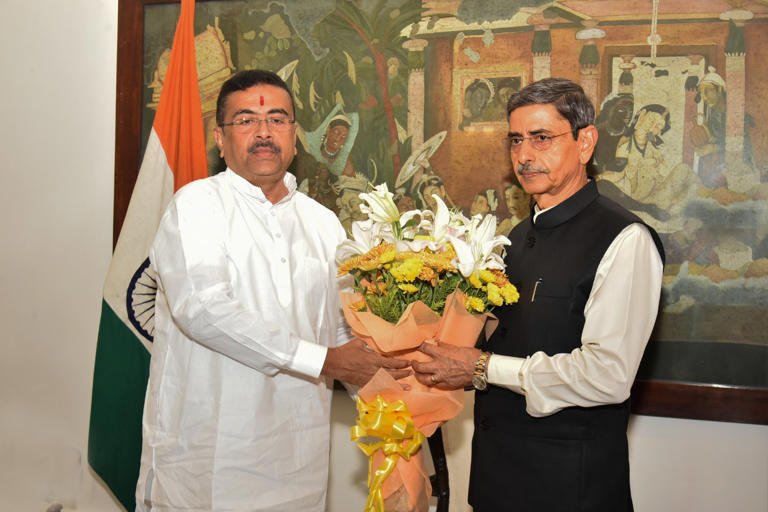
Leader of Opposition in West Bengal Assembly Suvendu Adhikari alleged that nearly 30 lakh beneficiaries receiving benefits under the Trinamool Congress government’s direct cash transfer scheme for women are ineligible and called for a detailed verification process to review beneficiary records.
The allegation has triggered fresh political debate in West Bengal over welfare delivery, beneficiary identification, and implementation of government schemes. The issue has gained attention because the direct benefit programme remains one of the state’s most prominent welfare initiatives focused on financial assistance for women.
Suvendu Adhikari made the remarks while raising questions regarding beneficiary eligibility and urging authorities to carry out stronger scrutiny of records.
Suvendu Adhikari Alleges Large-Scale Ineligible Beneficiary Inclusion
Addressing the issue, Suvendu Adhikari claimed that around 30 lakh recipients under the state government’s direct cash transfer programme for women do not meet eligibility requirements.
According to him, authorities should conduct detailed verification to identify individuals who may not qualify under existing scheme norms.
Adhikari argued that welfare initiatives achieve better outcomes when benefits reach intended recipients through accurate identification and administrative monitoring.
He maintained that transparency and accountability remain important for preserving public confidence in welfare programmes.
The opposition leader also alleged that verification mechanisms require strengthening to ensure efficient utilisation of public resources.
His remarks added another dimension to the political discussion surrounding welfare administration in the state.
Debate Intensifies Over Beneficiary Verification
The allegations have intensified discussion around beneficiary verification and implementation systems linked to direct benefit schemes.
Supporters of stronger verification argue that periodic reviews help maintain accuracy and improve delivery of welfare programmes.
According to observers, large-scale public schemes often require continued updating of beneficiary databases and administrative review.
Questions regarding eligibility, documentation, and verification have become common themes in political discussions around welfare programmes across states.
Adhikari stated that administrative mechanisms should regularly review records to reduce irregularities and improve efficiency.
He also called for institutional checks that strengthen accountability and maintain fairness in distribution.
The issue has therefore expanded beyond politics and moved into broader conversations on governance and welfare delivery.
Women’s Welfare Scheme Remains Politically Significant
The direct cash transfer programme for women remains one of the most visible welfare initiatives introduced by the West Bengal government.
The scheme provides financial support to eligible women beneficiaries and has featured prominently in public discussions around social welfare and economic support.
Supporters of the programme have argued that direct benefit transfers improve access and strengthen financial inclusion.
At the same time, political opponents continue raising questions regarding implementation and beneficiary selection.
Observers noted that welfare schemes often become central subjects of political debate because of their social and economic impact.
The latest allegations have once again brought attention to beneficiary management and administrative oversight.
The issue is likely to remain politically relevant in the coming period.
Opposition Calls For Greater Transparency
Suvendu Adhikari stated that transparency and effective monitoring remain necessary to maintain public confidence in welfare programmes.
According to him, verification processes should operate regularly to ensure that assistance reaches those who qualify.
He argued that public resources require careful management and stronger oversight mechanisms.
Political observers noted that calls for audits and reviews frequently emerge during discussions around large public schemes.
Supporters of beneficiary verification maintain that stronger monitoring supports efficiency and improves implementation.
At the same time, welfare advocates often emphasise ensuring that eligible beneficiaries do not face unnecessary administrative barriers.
The discussion therefore reflects broader questions around balancing accessibility and accountability.
Welfare Administration Remains Central To Political Debate
Welfare delivery and beneficiary management continue to remain important political issues in West Bengal.
Large-scale schemes often attract attention because of their role in social support and public policy.
Observers stated that discussions regarding eligibility and verification reflect wider debates around governance and programme effectiveness.
Political parties continue to present different approaches regarding monitoring, transparency, and delivery systems.
The latest comments from Suvendu Adhikari have intensified discussion around how welfare programmes should maintain accuracy and accountability.
At the same time, supporters of welfare expansion continue to emphasise accessibility and continuity.
Focus Turns To Verification And Administrative Response
Following the allegations, attention is expected to shift toward verification processes and possible administrative responses.
Observers believe the issue may continue to remain part of political discussion as parties debate welfare implementation and beneficiary management.
Authorities may continue reviewing records and maintaining procedures connected to scheme administration.
The latest remarks have renewed focus on the balance between expanding welfare coverage and ensuring accurate beneficiary identification.
As discussions continue, the debate surrounding eligibility, transparency, and public welfare delivery is expected to remain an important issue in West Bengal’s political landscape.