

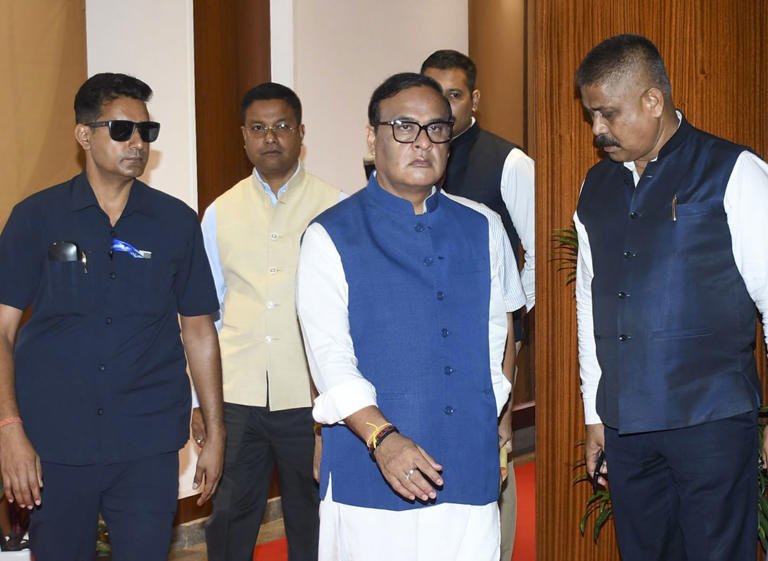
Assam Chief Minister Himanta Biswa Sarma launched a sharp political attack on the Congress during the debate on the Uniform Civil Code (UCC) in the Assam Assembly, claiming that the party had originally supported the idea nearly a century ago but had now shifted its political position.
During his address in the Assembly, Sarma argued that discussions around the Uniform Civil Code should not be viewed as a recent political agenda and asserted that historical records reflected earlier support for similar ideas within Congress circles. He also criticised the party’s present stance and alleged that its political approach had changed over time.
The remarks came during ongoing debate over the proposed Uniform Civil Code in Assam and added fresh intensity to political exchanges inside the Assembly.
Himanta Sarma Claims Congress Earlier Supported Uniform Civil Code
Speaking during the Assembly session, Himanta Biswa Sarma stated that Congress had first spoken in favour of a Uniform Civil Code in 1925 and argued that the current opposition to the proposal represented a shift from its earlier position.
According to the chief minister, the present debate should take historical context into account rather than treating the proposal as an entirely new policy direction.
Sarma argued that discussions around common civil laws existed long before contemporary political divisions and said historical political positions should remain part of public understanding.
The chief minister maintained that legal reform and civil law discussions have remained present in India’s public and political discourse for decades.
His remarks formed part of the government’s broader effort to defend the proposed legislation and counter criticism raised by opposition parties.
Supporters of the government’s position argued that historical references strengthen the case for continuing legal reform discussions.
Chief Minister Criticises Congress Over Current Position
During his speech, Sarma criticised Congress and alleged that the party no longer reflects the broader approach it once adopted.
He claimed that Congress currently represents narrower political interests and argued that the party’s opposition to the Uniform Civil Code differs from earlier positions.
The chief minister linked his criticism to the broader political debate around legal reform and governance.
According to Sarma, political parties should maintain consistency while discussing issues related to national policy and legal frameworks.
He stated that policy discussions should remain focused on principles and long-term objectives rather than short-term political considerations.
The comments triggered responses across political circles and added to ongoing exchanges surrounding the proposed legislation.
Observers noted that the Assembly debate reflected larger political narratives beyond the text of the proposed law.
Uniform Civil Code Debate Intensifies In Assam Assembly
The Uniform Civil Code has emerged as one of the most discussed issues in the current Assembly session.
Supporters of the proposal argue that a common legal framework could promote equality and simplify civil matters related to marriage, inheritance, succession, and family law.
Government representatives have repeatedly stated that the proposed framework focuses on civil issues and not religious practices.
At the same time, opposition leaders continue raising concerns regarding implementation and consultation.
Political critics argue that reforms of this scale require broader public engagement and careful examination.
The Assembly discussions therefore expanded into larger questions regarding legal reform, constitutional principles, and public policy.
The latest remarks by Himanta Sarma further intensified these discussions.
Government Defends UCC As Governance Reform
The Assam government has consistently presented the Uniform Civil Code as part of a wider reform agenda.
During the Assembly debate, government leaders argued that the objective of the proposal is to create legal consistency and strengthen equal treatment under civil law.
Supporters maintain that a common framework can reduce differences in legal treatment across categories of civil matters.
Officials also stated that governance reforms should focus on clarity, accountability, and long-term institutional outcomes.
The government continued to reject suggestions that the proposal targets any specific religious community.
Instead, leaders maintained that the focus remains on legal administration and civil regulation.
The Assembly debate reflected these competing interpretations of the proposed framework.
Opposition Continues To Raise Questions
Opposition parties continued to challenge the government’s position during the discussion.
Leaders argued that legal reforms involving personal matters require broader consultation and detailed public discussion.
Opposition representatives also questioned the timing and broader implications of the proposal.
Political observers noted that the debate around the Uniform Civil Code extends beyond Assam and remains an important national issue.
Different political parties continue presenting contrasting views regarding implementation and social impact.
The Assembly proceedings highlighted these differences and reflected the intensity of political disagreement.
The issue is expected to remain central to discussions in the coming period.
UCC Remains At Centre Of Political And Policy Discussions
The Uniform Civil Code continues to remain among the most debated public policy issues in India.
Supporters describe it as a step toward legal uniformity and equal civil treatment, while critics emphasise consultation and implementation concerns.
Himanta Sarma’s remarks in the Assam Assembly added a historical and political dimension to the ongoing debate.
By referring to Congress’s earlier position and criticising its current approach, the chief minister attempted to frame the discussion as a question of political consistency.
As debate over the proposed legislation continues, the issue is expected to remain a major political subject both inside the Assam Assembly and in wider national discussions surrounding legal reform and governance.