

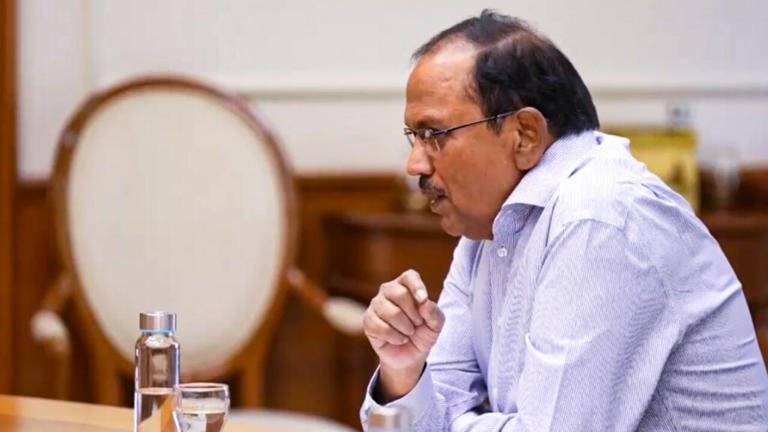
National Security Adviser Ajit Doval is set to visit Beijing for a fresh round of high-level India-China border talks with Chinese Foreign Minister Wang Yi. The discussions come at an important time for bilateral relations, as Chinese President Xi Jinping is expected to visit India for the BRICS Summit in New Delhi next month.
Doval and Wang Yi are scheduled to hold the 25th round of talks under the Special Representatives mechanism. The dialogue will focus on the long-standing boundary dispute and the need to maintain peace and stability along the Line of Actual Control (LAC).
The meeting could also help prepare the ground for further high-level engagement between India and China. Xi is expected to attend the BRICS Summit in New Delhi on September 12 and 13, although his participation has not yet received formal confirmation.
Ajit Doval and Wang Yi to Hold 25th Round of Talks
Ajit Doval will represent India as its Special Representative for the boundary negotiations. Wang Yi will represent China in the dialogue.
India and China created the Special Representatives mechanism in 2003 to address the complex boundary issue. The mechanism has remained an important channel for dialogue between the two countries, especially during periods of tension.
The latest meeting comes after several efforts by both sides to stabilise relations following the military tensions along the border in eastern Ladakh.
The talks will focus on managing the unresolved boundary issue and preventing fresh tensions along the LAC. Both sides are expected to discuss practical measures that can strengthen peace and improve communication.
Border Stability and De-Escalation Top the Agenda
Border stability is expected to remain the main focus of the discussions in Beijing.
The two sides are likely to review the situation along the 3,488-km Line of Actual Control. They may discuss troop deployment, border management and measures to prevent military tensions.
The discussions may also focus on confidence-building measures. These steps can help reduce the risk of misunderstandings and allow military and diplomatic channels to respond quickly to any emerging situation.
India and China are expected to review progress made since the disengagement arrangements reached in October 2024.
The two countries may also discuss ways to consolidate those arrangements and ensure that stability continues along sensitive border areas.
Patrolling and Border Management May Be Discussed
Patrolling arrangements could form another important part of the agenda.
The October 2024 understanding helped both sides move towards disengagement at key friction points. The upcoming talks may assess the implementation of these arrangements and examine further steps to manage the border situation.
India has consistently maintained that peace and tranquillity along the border are essential for the normal development of bilateral relations.
The Doval-Wang Yi meeting will therefore carry significance beyond the boundary issue. Progress on border stability could influence the broader relationship between the two Asian powers.
The talks may also examine existing communication channels and mechanisms that help the two sides manage sensitive situations along the LAC.
Broader India-China Relations Also in Focus
The meeting is expected to go beyond military and border issues.
Doval and Wang Yi may take stock of the broader India-China relationship and review recent efforts to stabilise ties. Both countries have taken steps in recent years to restore engagement after relations suffered a major setback following the 2020 Galwan Valley clash.
The discussions could examine the next steps for normalising bilateral ties. Trade, people-to-people exchanges and other areas of engagement may become easier to advance if the border remains peaceful.
However, the boundary dispute will continue to remain a major factor in the relationship.
For India, lasting improvement in ties depends heavily on maintaining peace along the border.
Xi Jinping’s Expected India Visit Adds Significance
The timing of Doval’s Beijing visit has given the talks added importance.
Chinese President Xi Jinping is expected to visit India for the BRICS Summit in New Delhi on September 12 and 13. If Xi attends, the visit could provide an opportunity for further engagement with Prime Minister Narendra Modi. However, there has been no official confirmation of Xi’s participation so far.
A positive outcome from the Doval-Wang Yi meeting could help create a favourable atmosphere before the summit.
The visit could also serve as part of broader diplomatic preparations for possible high-level India-China discussions during the BRICS meeting.
Reports have also suggested that Doval’s Beijing visit could involve other high-level engagements, although no official details have confirmed such meetings.
Why the Beijing Talks Matter
The 25th round of Special Representatives talks will test the progress made by India and China in managing their differences.
The immediate goal is unlikely to be a final settlement of the decades-old boundary dispute. Instead, the focus is expected to remain on maintaining stability, preventing fresh confrontations and improving border management.
The talks could also provide both countries with an opportunity to assess the wider direction of bilateral relations.
Any progress in Beijing may help build confidence before the BRICS Summit. A stable border environment could make it easier for New Delhi and Beijing to expand diplomatic engagement.
At the same time, major differences remain. The boundary issue continues to require sustained negotiations and long-term political engagement.
What to Watch Next
The outcome of Doval’s talks with Wang Yi will offer an important indication of how India and China plan to manage their relationship in the coming months.
Observers will closely watch for any new understanding on border stability, troop deployment, patrolling arrangements or confidence-building measures.
The discussions will also be significant because they take place shortly before Xi Jinping’s expected India visit for the BRICS Summit.
For now, the agenda centres on maintaining peace along the LAC, reviewing de-escalation efforts and strengthening border management.
The broader objective is to prevent the boundary dispute from triggering another major crisis while allowing diplomatic engagement to continue.
If the Beijing talks produce positive results, they could help set the stage for further India-China engagement at the BRICS Summit in New Delhi. The meeting between Ajit Doval and Wang Yi will therefore be closely watched as an important step in the ongoing effort to stabilise one of Asia’s most complex bilateral relationships.