

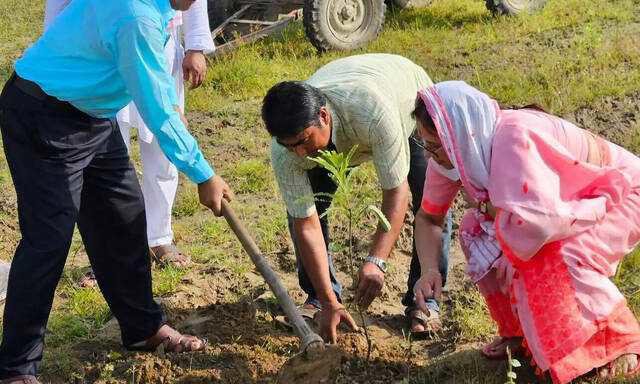
The Assam government has launched an ambitious initiative to strengthen horticulture across the state by promoting large-scale plantation and the distribution of saplings. The programme aims to put 25 crore saplings into the hands of farmers and encourage them to shift towards high-value horticultural crops.
The initiative seeks to increase farm incomes, promote crop diversification and create new opportunities in fruit and cash-crop cultivation. It also forms part of the state’s broader effort to make agriculture more commercially viable and reduce farmers’ dependence on traditional crops.
Assam has favourable climatic conditions for a wide range of fruits, vegetables, spices, flowers and medicinal plants. The state government’s industries and commerce department identifies horticulture as a sector with strong growth potential and opportunities for processing, packaging and value addition.
Government Targets Large-Scale Sapling Plantation
The proposed distribution of 25 crore saplings represents a major push towards expanding horticultural cultivation in Assam.
The government wants farmers to make greater use of their available land by introducing commercially valuable crops. Instead of relying on a single crop, farmers can cultivate several varieties and create multiple sources of income.
The approach can also support mixed and multi-cropping systems. Such systems allow farmers to grow different crops on the same land and earn returns at different times of the year.
Assam already has experience with large-scale sapling distribution and plantation programmes. The state has promoted commercial tree plantation through initiatives such as the Amrit Brikshya Andolan, which aims to expand tree cover while supporting the green economy and agroforestry.
Focus on High-Value Horticultural Crops
The new initiative places greater emphasis on crops that can provide farmers with better economic returns.
Horticulture includes fruits, vegetables, flowers, spices and medicinal plants. Assam’s climate supports many such crops, giving farmers opportunities to diversify beyond conventional cultivation.
The Agriculture Department has already set ambitious targets for distributing high-yielding horticultural saplings. In July, Agriculture Minister Pijush Hazarika announced a target of distributing one crore high-yielding horticulture saplings across the state and encouraged farmers to focus on fruit and cash-crop cultivation.
The latest 25-crore target would represent a much larger expansion of this approach.
Farmers Can Diversify Their Income
Crop diversification can help farmers reduce their dependence on a single agricultural product.
Farmers can cultivate combinations such as coconut, pineapple, black pepper and dragon fruit, depending on local soil and climatic conditions. Hazarika has previously encouraged systematic multi-cropping of such crops on the same land to increase economic benefits for farming families.
This model can provide farmers with different sources of income. Some crops may generate returns within a shorter period, while fruit trees and other perennial crops can provide longer-term earnings.
Diversification can also reduce the impact of a poor harvest in one crop.
Assam Has Strong Horticulture Potential
Assam’s geographical and climatic conditions provide a strong foundation for horticulture.
The state can produce a wide variety of fruits, vegetables, spices and medicinal plants. The government’s industries and commerce department has identified opportunities not only in cultivation but also in sourcing, processing, extraction and packaging.
This means the horticulture sector can create opportunities beyond farming.
Once farmers increase production, businesses can develop around storage, transportation, food processing and packaging. Such activities can create additional employment in rural areas.
The government therefore sees horticulture as part of a larger agricultural value chain.
Saplings Can Strengthen Rural Livelihoods
Providing quality planting material remains an important part of expanding horticulture.
Farmers often need access to healthy and high-yielding varieties if they want to establish productive orchards or commercial plantations. Government-supported nurseries can help meet this requirement.
Assam already has programmes that support nursery development and the distribution of planting materials. Under the PM-RKVY Agroforestry programme, the state has received support for nurseries, training and free sapling distribution. The programme has also supported agroforestry in districts including Karbi Anglong and Dima Hasao.
The government can build on this existing infrastructure to support the larger horticulture drive.
Better Planting Material Can Improve Productivity
The success of a large plantation programme will depend heavily on the quality of the saplings.
Healthy planting material can improve survival rates and increase the productivity of horticultural farms. Farmers also need technical guidance on planting, irrigation, pruning, pest management and harvesting.
Assam’s State Bamboo Development Agency, for example, promotes different categories of nurseries and emphasises certified planting material, irrigation systems and proper nursery management.
Similar standards can help the horticulture programme deliver better results.
Post-Harvest Management Will Be Important
Increasing production alone will not guarantee higher farmer incomes.
Horticultural crops are often perishable. Farmers need adequate storage, transportation and processing facilities to prevent wastage and protect the value of their produce.
The Assam government has identified the lack of processing infrastructure as a challenge for the food-processing sector. It has also highlighted opportunities in logistics and cold chains.
The expansion of horticulture will therefore need to go hand in hand with stronger post-harvest infrastructure.
Cold storage facilities can help farmers preserve fruits and vegetables for longer periods. Processing units can also turn fresh produce into juices, jams, dried products, spices and other value-added goods.
Market Access Will Determine Success
Farmers also need reliable markets for their produce.
If production rises sharply without a corresponding increase in demand, farmers could face lower prices. The government will therefore need to connect horticultural producers with organised markets, processors, retailers and consumers.
Farmer Producer Organisations can play an important role in this process. By working collectively, farmers can improve their bargaining power and reduce some marketing costs.
Digital platforms can also help connect producers with buyers and provide information about prices and demand.
Horticulture Can Create Rural Employment
The horticulture initiative could generate employment beyond farming.
Plant nurseries, transportation, processing, packaging and marketing all require workers. As production increases, rural entrepreneurs may also establish small businesses around agricultural products.
Young people can find opportunities in areas such as food processing, agricultural technology, logistics and farm management.
The government has already encouraged Assam’s youth to consider commercial farming rather than leaving rural areas in search of low-skilled employment.
A stronger horticulture sector could support this goal by making agriculture more commercially attractive.
Sustainable Agriculture Remains Important
The large-scale plantation programme also has an environmental dimension.
Trees and perennial crops can contribute to soil conservation, biodiversity and carbon storage when farmers manage plantations sustainably. Agroforestry can also combine agricultural production with tree cultivation.
Government programmes in Assam already promote tree-based farming systems and agroforestry as ways to diversify rural incomes.
The horticulture initiative can therefore support both economic and environmental objectives if farmers receive proper guidance on sustainable cultivation.
Assam Pushes Towards a Horticulture Economy
The Assam horticulture initiative 2026 marks a major effort to expand the state’s horticultural base and improve agricultural livelihoods.
The proposed 25-crore-sapling drive can give farmers access to more commercial crops and encourage them to diversify their land. Fruits, spices, vegetables and other high-value crops could provide new income opportunities for rural households.
However, the success of the programme will depend on more than the number of saplings planted. Farmers will need quality planting material, technical assistance, irrigation, storage, processing facilities and reliable markets.
The government will also need to monitor how many saplings survive and how effectively farmers adopt the new crops.
If these elements come together, the initiative could help Assam move beyond traditional farming models and develop a stronger horticulture value chain. It could increase farm incomes while creating new opportunities in processing, logistics and rural entrepreneurship.
For Assam’s farmers, the large-scale sapling programme could therefore become an important step towards more diversified, commercially viable and sustainable agriculture.