

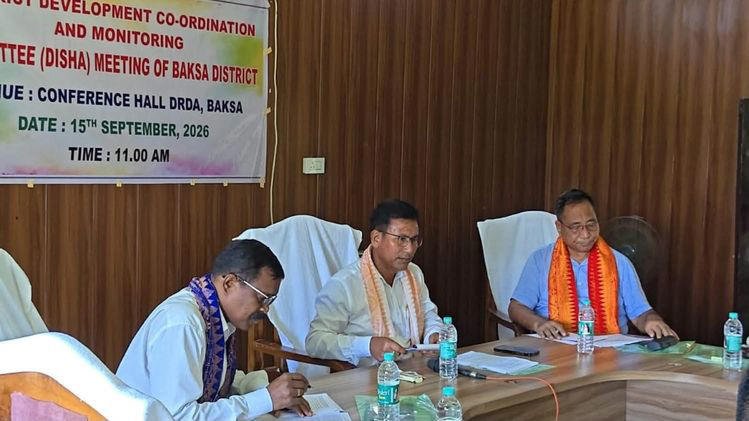
A District Development Coordination and Monitoring Committee (DISHA) meeting was held in Assam’s Baksa district to review the progress of various centrally sponsored schemes and assess their implementation at the grassroots level. The meeting focused on ensuring that government programmes reach eligible beneficiaries effectively and that ongoing development projects are completed within the stipulated time.
The meeting brought together elected representatives, district administration officials and officials from different departments responsible for implementing central government schemes across the district. Discussions centred on the progress of key welfare and development programmes, with particular attention given to identifying gaps in implementation and addressing issues that could delay the delivery of benefits.
Officials presented updates on the implementation of various schemes and development initiatives being undertaken in Baksa. The committee examined the progress achieved so far and discussed the challenges faced by departments in carrying out projects and delivering services to people in rural and remote areas.
The DISHA platform plays an important role in monitoring the implementation of centrally sponsored schemes at the district level. It provides an opportunity for elected representatives and administrative officials to jointly assess whether government programmes are being implemented according to prescribed guidelines and whether their intended benefits are reaching people on the ground.
During the meeting, participants stressed the importance of effective coordination between different departments and agencies. Officials were encouraged to maintain regular monitoring of projects and ensure that beneficiaries do not face unnecessary difficulties in accessing government assistance.
The discussions also highlighted the need for timely completion of infrastructure and development works. Delays in implementation can affect the delivery of essential services and reduce the intended impact of government schemes. The committee therefore emphasised close supervision of projects and prompt action to resolve administrative or technical difficulties.
Particular attention was given to ensuring transparency and accountability in the implementation process. Officials were urged to maintain proper records and regularly update progress so that the performance of schemes can be assessed effectively. Monitoring mechanisms were also discussed as an important tool for identifying shortcomings and taking corrective measures.
The meeting provided an opportunity to review the impact of central schemes on communities across Baksa. Government programmes covering areas such as rural development, housing, sanitation, employment, roads, healthcare, education and social welfare are intended to improve living conditions and strengthen basic infrastructure, particularly in rural areas.
Participants stressed that successful implementation depends not only on the allocation of funds but also on efficient execution at the local level. District officials were asked to ensure that approved projects are implemented according to their objectives and that resources are used efficiently.
The committee also discussed the importance of ensuring that eligible beneficiaries are identified correctly. In many government welfare programmes, accurate identification of beneficiaries is essential to prevent exclusion and ensure that assistance reaches the people for whom the schemes are intended.
The district administration was also encouraged to strengthen field-level monitoring. Regular visits and inspections can help officials understand the actual situation on the ground and identify problems that may not be immediately visible through administrative reports.
The DISHA meeting comes as governments continue to place emphasis on improving the delivery of central schemes and strengthening coordination between different levels of administration. District-level monitoring remains particularly important in areas where geographical challenges and limited connectivity can affect the implementation of development programmes.
Baksa, like several other districts in Assam, has a substantial rural population and communities spread across different areas. Ensuring that development initiatives reach these communities requires coordination among district authorities, local institutions and implementing agencies.
Officials participating in the meeting were asked to work towards improving the pace and quality of implementation while maintaining transparency in the use of public resources. The focus remained on translating government schemes and policy decisions into tangible benefits for people at the grassroots level.
The meeting also reinforced the importance of regular reviews rather than waiting until the completion of a project to assess its performance. Periodic monitoring allows authorities to identify delays, financial or administrative issues and other obstacles at an early stage, making it easier to introduce corrective measures.
The DISHA mechanism is designed to strengthen this monitoring process by bringing different stakeholders together. Through such meetings, elected representatives can raise concerns regarding development works in their constituencies, while officials can provide updates and explain the steps being taken to address implementation-related challenges.
The Baksa meeting concluded with an emphasis on coordinated efforts to improve the effectiveness of central schemes in the district. Authorities reiterated the need for timely execution, proper monitoring and greater focus on beneficiary-oriented implementation.
The discussions are expected to help district authorities identify areas requiring greater attention and strengthen the delivery of development programmes across Baksa. By focusing on effective implementation and regular monitoring, the administration aims to ensure that government initiatives produce visible and meaningful outcomes for local communities.
The review ultimately underlined that the success of any government scheme depends on how effectively it is implemented at the grassroots level. For Baksa, continued coordination between elected representatives, officials and local stakeholders will remain important in ensuring that development programmes are delivered efficiently and that their intended benefits reach the people.