

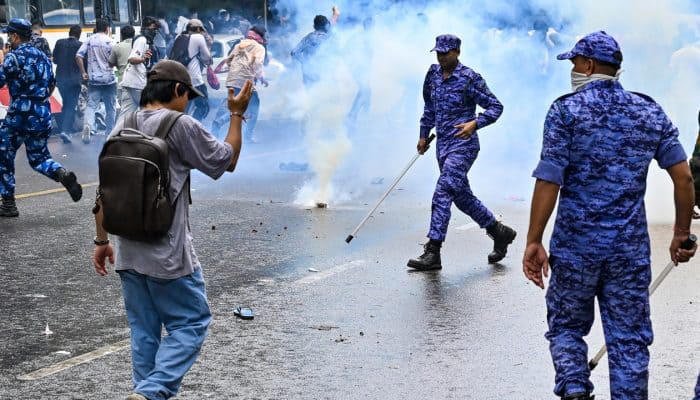
The ongoing Cockroach Janta Party (CJP) protest in Delhi witnessed several major developments as activist Sonam Wangchuk’s health was reported to be stable, the Delhi Police registered an FIR over the violence during the “Sansad Chalo” protest, and CJP founder Abhijeet Dipke strongly criticised what he described as police brutality against demonstrators.
The developments come a day after clashes between protesters and police near Parliament, which left several people injured and triggered widespread political reactions. While authorities defended their crowd-control measures, protest organisers alleged excessive use of force against peaceful demonstrators.
The situation remains tense as protests continue at Jantar Mantar, with political leaders, civil society groups, and legal representatives closely monitoring the developments.
Sonam Wangchuk’s Health Reported Stable
During proceedings before the Delhi High Court, lawyers representing Sonam Wangchuk informed the court that his vital signs were stable, although medical monitoring remained necessary. Following the hearing, the court permitted his transfer from Safdarjung Hospital to Medanta Hospital, where a specialised medical panel will supervise his treatment.
The Centre informed the court that it had no objection to Wangchuk being shifted to a hospital of his choice, provided medical advice was followed. His wife had approached the court seeking permission for the transfer, arguing that he should be treated at a hospital selected by the family.
Wangchuk has been on a hunger strike in solidarity with the CJP movement, making his health a central concern throughout the ongoing protests.
Delhi Police Register FIR Over Protest Violence
Delhi Police have registered a First Information Report (FIR) in connection with the violence that erupted during the “Sansad Chalo” march.
According to the police, the FIR includes allegations that some protesters resorted to stone-pelting and attempted to breach security barricades near Parliament. Police officials have defended their actions, stating that repeated warnings were issued before force was used to disperse the crowd.
The FIR forms part of the official investigation into the clashes, with authorities examining video footage and other evidence to determine the sequence of events.
Dipke Accuses Police of Brutality
CJP founder Abhijeet Dipke strongly criticised the police response, alleging that excessive force was used against peaceful protesters.
Speaking at the protest site, Dipke questioned the handling of the demonstration and condemned the injuries suffered by several participants. He alleged that young protesters had been subjected to unnecessary violence and stated that the movement would continue despite the crackdown. These allegations have not been independently verified.
Dipke also urged supporters not to lose hope, describing the protest as part of a larger movement seeking accountability on issues affecting students and young people.
Police Defend Their Actions
Delhi Police have maintained that force was used only after protesters allegedly attempted to cross barricades and ignored repeated warnings.
Senior police officials stated that security arrangements around Parliament required strict enforcement and that officers acted to prevent unauthorised access to restricted areas. According to police, crowd-control measures were implemented only after protesters allegedly became unruly.
The police have rejected allegations of indiscriminate violence, insisting that their actions were carried out in accordance with law and established procedures.
Political Reactions Intensify
The confrontation has drawn sharp political reactions from across the opposition.
Several opposition leaders visited injured protesters at hospitals and demanded a discussion in Parliament on the police action. They criticised the government’s handling of the protest and called for accountability regarding the injuries sustained during the clashes.
Meanwhile, Union Health Minister J.P. Nadda visited injured protesters and met doctors treating those admitted to hospital, while also holding discussions with medical teams overseeing their care.
Protest Continues at Jantar Mantar
Despite the clashes, demonstrations continued at Jantar Mantar, where supporters gathered for a second consecutive day.
CJP leaders indicated that the movement would continue through peaceful protests while legal proceedings and discussions with the government progress. Protest organisers have reiterated their demands, including accountability on issues that triggered the demonstrations.
Authorities continue to maintain heightened security around central Delhi, with restrictions remaining in place near sensitive government locations.
Delhi High Court Monitoring Related Issues
The Delhi High Court has been hearing petitions connected to Sonam Wangchuk’s treatment as well as matters arising from the protests.
Separately, the High Court agreed to hear a petition alleging excessive use of force by Delhi Police during the demonstration. The petition seeks judicial scrutiny of the events that unfolded during the protest march.
The court’s proceedings are expected to remain an important aspect of the evolving developments surrounding the protests.
Protest Movement Gains Wider Attention
The CJP protest has grown into one of the most closely watched demonstrations in recent weeks, attracting widespread public attention and political debate.
Supporters describe the movement as a campaign seeking accountability and institutional reforms, while authorities continue to emphasise the need to maintain public order and enforce security regulations. The contrasting narratives from protesters and law enforcement have intensified public discussion over the events surrounding the march.
Situation Remains Fluid
With Sonam Wangchuk’s condition reported to be stable, legal proceedings continuing, and the Delhi Police investigation now underway following the registration of an FIR, the situation surrounding the CJP protest remains dynamic.
As Abhijeet Dipke continues to criticise the police response and authorities defend their actions, the developments are expected to remain under close public and judicial scrutiny. The coming days are likely to determine how both the legal process and the broader protest movement evolve amid continuing political attention.