

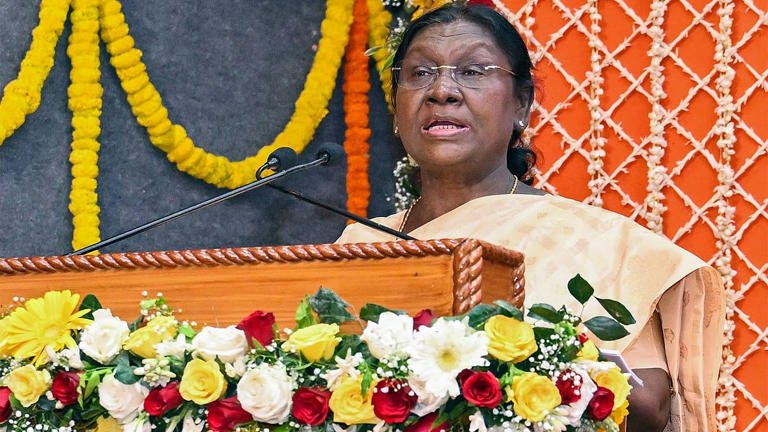
President Droupadi Murmu has urged students of Andhra University to move beyond classroom learning and draw knowledge from the world around them, emphasising that true education extends far beyond textbooks. Addressing students during her visit to the university, the President highlighted the importance of experiential learning, critical thinking, and active engagement with society in shaping responsible, innovative, and compassionate citizens.
She said that while academic excellence provides a strong foundation, students should also learn from their surroundings, communities, culture, environment, and real-life experiences to develop a broader perspective on life. Such an approach, she noted, equips young people with the skills and values needed to address contemporary challenges and contribute meaningfully to nation-building.
The President encouraged students to remain curious, embrace lifelong learning, and use their education to create a positive impact on society.
Education should go beyond classroom boundaries
Addressing the gathering, President Murmu stressed that education should not be confined to textbooks, examinations, or classrooms alone. She observed that every individual is surrounded by an ecosystem that offers valuable opportunities for learning, whether through interactions with people, observing nature, participating in community activities, or understanding local traditions and cultures.
According to the President, experiential learning helps students develop practical knowledge, emotional intelligence, and problem-solving abilities that complement formal education.
She urged young learners to remain open to new experiences and continuously seek knowledge from diverse sources throughout their lives.
Importance of connecting knowledge with society
The President highlighted the need for students to apply academic knowledge to real-world situations.
She said universities should encourage learners to understand the social, economic, and environmental challenges facing communities and explore innovative solutions through research, creativity, and collaboration.
By engaging directly with society, students can better appreciate the relevance of their education while developing a stronger sense of responsibility towards the nation.
President Murmu observed that higher education institutions play an important role in nurturing socially conscious graduates capable of contributing to inclusive and sustainable development.
Universities as centres of innovation and research
Speaking about the role of universities, the President emphasised that higher educational institutions must become centres of innovation, research, and intellectual excellence.
She encouraged students to cultivate scientific temper, creativity, and independent thinking while pursuing academic excellence.
Research, she noted, should not only advance knowledge but also address practical challenges faced by society, industry, agriculture, healthcare, and environmental conservation.
The President urged universities to create an environment that supports innovation, interdisciplinary collaboration, and entrepreneurship among students.
Youth have a vital role in nation-building
President Murmu said India’s youth represent one of the country’s greatest strengths and have a significant role to play in shaping its future.
She encouraged students to use their education, talents, and skills for the benefit of society while contributing to the country’s economic, technological, and social development.
According to the President, young people possess the energy, creativity, and determination required to address emerging national and global challenges.
She called upon students to become responsible citizens who uphold democratic values, respect diversity, and work towards the collective progress of the nation.
Emphasis on values alongside academic excellence
The President observed that education should not only develop intellectual abilities but also strengthen moral values and ethical conduct.
She stressed the importance of integrity, compassion, discipline, humility, and respect for others as essential qualities of responsible citizens.
Academic success, she said, becomes truly meaningful when accompanied by strong character and a commitment to public service.
Students were encouraged to uphold honesty, social responsibility, and empathy while pursuing personal and professional achievements.
The President noted that value-based education contributes to building a more harmonious and progressive society.
Learning from nature and local communities
President Murmu also encouraged students to appreciate the lessons that can be learned from nature, local communities, and cultural heritage.
She observed that India’s diverse traditions, indigenous knowledge systems, and ecological richness offer valuable insights into sustainable living and responsible resource management.
Understanding local ecosystems, she said, enables students to develop a deeper appreciation for environmental conservation and community resilience.
She urged educational institutions to promote greater interaction between academic learning and local knowledge, thereby enriching students’ educational experiences.
Encouraging innovation and entrepreneurship
The President called upon students to embrace innovation and entrepreneurship as important drivers of national development.
She encouraged young innovators to identify societal challenges and develop practical solutions using science, technology, and creativity.
Universities, she said, should continue supporting startups, research initiatives, and innovation ecosystems that enable students to transform ideas into impactful enterprises.
The President also highlighted the importance of collaboration between academia, industry, and government in promoting research-led economic growth.
Preparing students for a changing world
Highlighting the rapidly evolving global landscape, President Murmu said students must equip themselves with knowledge, adaptability, and lifelong learning skills to succeed in the future.
Technological advancements, digital transformation, artificial intelligence, and changing employment patterns require continuous learning and professional development.
She encouraged students to remain flexible, develop multidisciplinary skills, and cultivate a global outlook while staying rooted in India’s cultural values.
According to the President, education should empower individuals to confidently navigate changing circumstances while contributing positively to society.
Inspiring holistic education for future generations
President Droupadi Murmu’s address to Andhra University students underscored the importance of holistic education that combines academic excellence with practical learning, ethical values, and social responsibility. By encouraging students to go beyond textbooks and learn from their surrounding ecosystem, she highlighted the transformative potential of experiential learning in shaping capable, compassionate, and innovative citizens.
As India continues to strengthen its higher education system, the President’s message reinforces the need for universities to nurture curiosity, research, creativity, and community engagement alongside classroom instruction. Her call for lifelong learning and meaningful societal contribution serves as an inspiration for students to become active participants in building a more inclusive, sustainable, and knowledge-driven nation.