

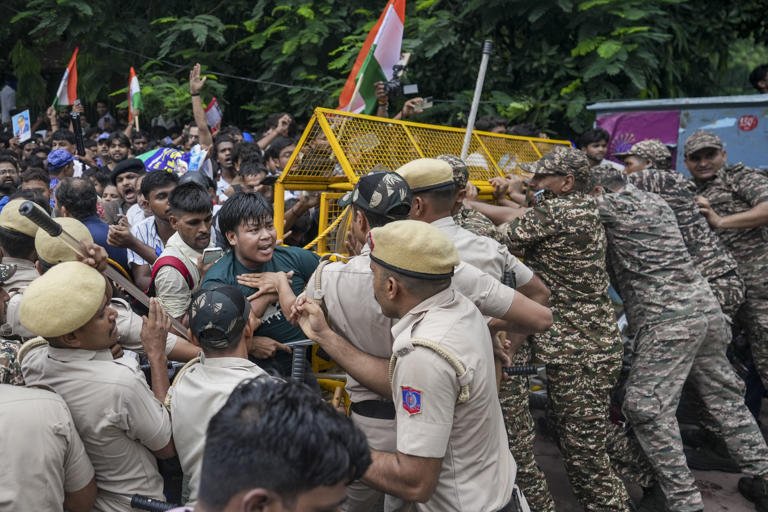
A senior leader of the Communist Party of India (Marxist) [CPI(M)] in Himachal Pradesh has strongly criticised the police action against protesters during the ongoing Cockroach Janta Party (CJP) agitation in Delhi. Condemning what the party described as a crackdown on peaceful demonstrators, the CPI(M) leader urged the country’s youth to respond through democratic means by voting against the Narendra Modi-led government in future elections.
The remarks come amid continuing political debate over the police action during the CJP’s “Sansad Chalo” protest, which resulted in clashes between protesters and security personnel. The incident has drawn sharp reactions from several opposition parties, civil society organisations, and activists, while the government and Delhi Police have defended their handling of the situation.
The CPI(M) leader said that democratic protests are an essential part of India’s constitutional framework and should be respected.
CPI(M) Condemns Protest Crackdown
Addressing party workers and supporters, the Himachal Pradesh CPI(M) leader criticised the police action against CJP protesters, alleging that peaceful demonstrations were met with excessive force.
The leader argued that citizens have the constitutional right to assemble peacefully and express their views on public issues. According to the CPI(M), the response to the protest has raised concerns regarding the protection of democratic freedoms and the right to dissent.
The party maintained that governments should engage in dialogue with protesters rather than relying on coercive measures to manage public demonstrations.
Appeal to Young Voters
During the address, the CPI(M) leader called upon young people to express their political views through the democratic process.
Urging youth participation in elections, the leader appealed to voters to seek political change through the ballot box if they were dissatisfied with the government’s policies and handling of public issues.
The remarks emphasised electoral participation as the appropriate constitutional method for bringing about political change, while encouraging young citizens to remain actively engaged in democratic processes.
The appeal formed a central part of the party’s response to the recent developments surrounding the protests.
Reaction to the CJP Protest
The CPI(M)’s statement comes in the wake of the confrontation between CJP protesters and Delhi Police during the “Sansad Chalo” march.
The protest attracted nationwide attention after clashes reportedly left several people injured and led to the registration of criminal cases by Delhi Police. Protest organisers alleged excessive use of force, while police stated that action was taken after protesters attempted to breach security barricades and ignored repeated warnings.
The differing accounts have intensified political debate, with opposition parties demanding accountability and the government defending the actions of law enforcement agencies.
Democracy and the Right to Dissent
The CPI(M) leader argued that the right to protest peacefully is an essential pillar of democratic governance.
According to the party, public demonstrations provide citizens with an opportunity to voice concerns and participate in democratic discourse. The leader maintained that governments should protect these constitutional rights while ensuring public order through proportionate measures.
The remarks echoed the party’s long-standing position that democratic institutions must safeguard both freedom of expression and peaceful assembly.
The issue has become a key point of discussion following recent protest-related developments.
Government and Police Position
While opposition parties have criticised the handling of the protests, Delhi Police have maintained that their actions were necessary to preserve law and order.
Police officials stated that protesters allegedly attempted to cross security barricades and enter restricted areas despite repeated warnings. According to the authorities, crowd-control measures were implemented only after the situation escalated.
The government has also defended the police response, emphasising that maintaining security around Parliament and other sensitive locations remains a priority.
Investigations into the incidents continue following the registration of an FIR related to the clashes.
Political Reactions Continue
The police action has generated reactions from leaders across the political spectrum.
Several opposition parties have demanded an independent inquiry into the alleged use of force, while some leaders visited injured protesters and called for greater accountability.
Meanwhile, ruling party representatives have maintained that security agencies acted within the framework of the law and were required to prevent unauthorised access to restricted areas.
The incident has become a major political issue, with competing narratives emerging regarding the events that unfolded during the protest.
Youth and Democratic Participation
The CPI(M) leader placed particular emphasis on the role of young people in shaping the country’s democratic future.
The leader encouraged students and young voters to remain informed about public issues, participate in democratic processes, and exercise their voting rights responsibly.
According to the party, meaningful political change should be pursued through constitutional methods, including public debate, peaceful activism, and electoral participation.
The appeal reflected the CPI(M)’s broader emphasis on democratic engagement as the primary means of addressing political differences.
Continuing Debate Over Protest Rights
The events surrounding the CJP protest have reignited discussions on balancing the right to peaceful protest with the responsibility of authorities to maintain public order.
Legal experts and civil society organisations continue to debate the scope of constitutional protections for peaceful demonstrations and the circumstances under which law enforcement may intervene.
The issue is also expected to remain under judicial scrutiny as petitions related to the protests proceed before the courts.
The ongoing debate highlights the complex relationship between democratic freedoms, public safety, and law enforcement responsibilities.
Political Tensions Remain High
The criticism from the Himachal Pradesh CPI(M) leader adds to the growing political response following the CJP protest in Delhi. While the party has condemned the alleged crackdown and called on youth to seek political change through elections, the government and Delhi Police continue to defend their handling of the demonstrations.
As investigations, legal proceedings, and political debates continue, the incident is likely to remain a significant issue in the national political discourse, with discussions focusing on democratic rights, public accountability, and the role of peaceful protest in India’s constitutional framework.