

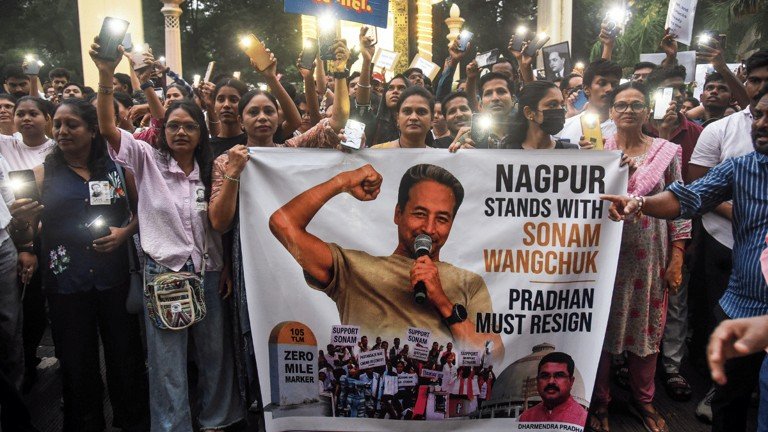
The Resident Doctors’ Associations (RDAs) of VMMC & Safdarjung Hospital and the All India Institute of Medical Sciences (AIIMS), New Delhi, have appealed to President Droupadi Murmu over the treatment of activist Sonam Wangchuk and the recent police action against protesters at Jantar Mantar. While Safdarjung doctors urged the President to safeguard Wangchuk’s rights as a patient, the AIIMS RDA called for an independent, impartial, and time-bound investigation into the alleged use of force during the protest.
The two medical bodies expressed concern over issues of patient autonomy, medical ethics, and the independence of healthcare institutions, arguing that hospitals should function solely as places of healing and not appear to serve as extensions of law enforcement.
Their appeals have intensified the debate surrounding Wangchuk’s hospitalisation and the handling of the protest by authorities.
Safdarjung Doctors Appeal to the President
The Resident Doctors’ Association of VMMC & Safdarjung Hospital wrote to President Droupadi Murmu, expressing concern over reports that Sonam Wangchuk was allegedly not permitted to leave the hospital despite being medically competent to make decisions regarding his treatment.
The doctors argued that patients who are mentally competent have the right to make informed decisions about their medical care, including the option to refuse treatment or seek discharge against medical advice.
In their letter, they urged the President to protect Wangchuk’s rights and ensure that hospitals continue to function according to established principles of medical ethics and patient autonomy.
Hospitals Should Be Places of Healing
The Safdarjung RDA emphasised that hospitals are institutions dedicated to healing and patient care rather than detention or law enforcement.
The association expressed concern that any perception of external influence over medical decisions could undermine public confidence in healthcare institutions and compromise the professional independence of doctors.
According to the letter, preserving the autonomy of medical professionals is essential for maintaining ethical standards and protecting the trust between patients and healthcare providers.
AIIMS RDA Seeks Probe into Police Action
Separately, the Resident Doctors’ Association of AIIMS, New Delhi, appealed to the President for an independent, impartial, and time-bound inquiry into the alleged police action against protesters during the recent demonstration at Jantar Mantar.
The association stated that concerns had been raised regarding the reported use of force during the protest and stressed the importance of establishing the facts through an independent investigation.
The AIIMS doctors also voiced concern over Wangchuk’s prolonged hospitalisation and called for greater transparency in the handling of the case.
Concerns Over Medical Ethics
Both doctors’ associations highlighted broader issues relating to medical ethics and institutional independence.
They stressed that doctors should be allowed to make clinical decisions based solely on medical considerations without external influence. The associations argued that safeguarding patient rights, confidentiality, informed consent, and professional autonomy remains fundamental to ethical healthcare practice.
According to the letters, protecting these principles is essential for maintaining the credibility of public healthcare institutions.
Background to the Controversy
The appeals come amid the ongoing controversy surrounding Sonam Wangchuk’s hospitalisation following his prolonged hunger strike linked to the CJP-led protest movement.
His admission to Safdarjung Hospital and subsequent legal proceedings regarding his transfer to a private hospital have attracted significant public attention. The Delhi High Court has since permitted Wangchuk’s transfer to Medanta Hospital after hearing a plea filed by his wife.
The developments have sparked discussions on patient rights, medical autonomy, and the role of public institutions during politically sensitive situations.
Debate Over Patient Autonomy
Patient autonomy remains a central issue raised by both medical associations.
Doctors noted that competent adult patients generally have the right to participate in decisions concerning their treatment and hospitalisation. The associations argued that these rights should be respected while ensuring that appropriate medical advice and care continue to be provided.
The letters emphasised that protecting patient autonomy is a cornerstone of modern medical ethics and professional practice.
Calls for Institutional Independence
The doctors also stressed the need to preserve the independence of public healthcare institutions.
According to the associations, hospitals must remain neutral environments where medical decisions are guided exclusively by clinical judgment and patient welfare rather than external considerations.
They warned that any perception of hospitals functioning under the influence of non-medical authorities could weaken public trust in the healthcare system and create long-term concerns about institutional integrity.
Wider Public and Legal Attention
The interventions by the Safdarjung and AIIMS Resident Doctors’ Associations have added a new dimension to the ongoing public and legal discussions surrounding Wangchuk’s case.
Medical professionals, legal experts, and civil society groups continue to debate issues relating to patient rights, constitutional protections, medical ethics, and the conduct of authorities during public demonstrations.
The appeals to the President reflect growing concern within sections of the medical community regarding the broader implications of the case for healthcare institutions and democratic freedoms.
Debate Continues
The appeals by the Safdarjung and AIIMS Resident Doctors’ Associations underscore the growing concern among sections of the medical fraternity over patient autonomy, institutional independence, and the handling of the recent protests.
While Safdarjung doctors have urged the President to protect Sonam Wangchuk’s rights as a patient, the AIIMS RDA has called for an independent inquiry into the police action against protesters. As legal proceedings and public discussions continue, the case is expected to remain at the centre of debates on medical ethics, constitutional rights, and the independence of healthcare institutions.