

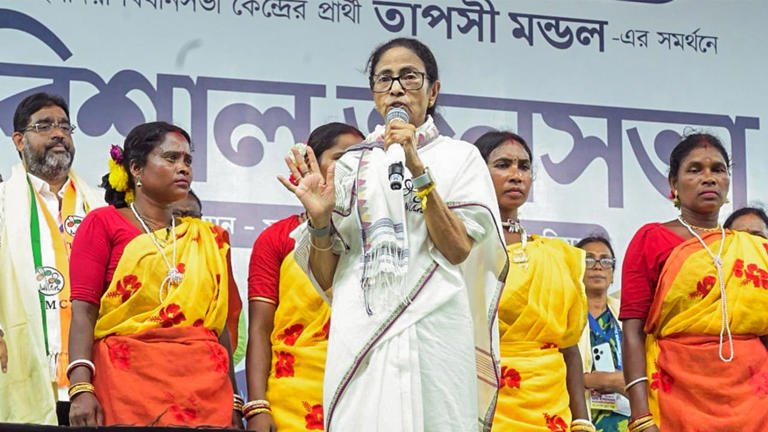
West Bengal Chief Minister Mamata Banerjee launched a sharp attack on the Bharatiya Janata Party (BJP), asserting that Bengal “will not be run from Delhi.” Her statement comes amid rising political tensions between the state government and the Centre.
The remark, delivered during a public address, quickly gained traction across political circles. It reflects the ongoing contest between regional and national political forces in West Bengal.
Read More: EC Issues Fresh Post-Poll Guidelines for Bengal Assembly Elections
Assertion of State Autonomy
Mamata Banerjee emphasized the importance of federal principles in India’s governance structure. She argued that states must have the freedom to make decisions based on local needs and priorities.
According to her, external interference in state affairs undermines democratic values. Therefore, she reiterated that Bengal’s प्रशासन will remain guided by its own leadership.
This stance aligns with her long-standing position on protecting state rights. Over the years, she has frequently highlighted the need for balanced Centre-state relations.
BJP’s Position and Counterarguments
The BJP responded by defending its approach, stating that coordination between the Centre and states is essential for development. Party leaders argued that national policies aim to benefit all regions, including West Bengal.
They also accused the state government of politicizing governance issues. According to BJP representatives, cooperation rather than confrontation should be the focus.
However, the party continues to challenge the TMC’s policies, pointing to areas where they believe improvements are needed. This ongoing exchange has kept political tensions high.
Political Context in West Bengal
The statement comes at a time when political rivalry between the Trinamool Congress (TMC) and the BJP remains intense. Both parties have been actively campaigning and shaping narratives ahead of upcoming elections.
While TMC maintains its stronghold in the state, the BJP has expanded its presence in recent years. This has led to frequent clashes over policy, governance, and political messaging.
Mamata Banerjee’s latest remarks must be viewed within this broader context. They serve as both a defense of her government and a critique of the opposition.
Focus on Regional Identity and Governance
Regional identity plays a crucial role in West Bengal politics. Mamata Banerjee’s statement reinforces the idea that local leadership understands the state’s needs better than external authorities.
She highlighted the cultural and social uniqueness of Bengal, arguing that governance must reflect these characteristics. Moreover, she stressed that decisions should be made in consultation with local stakeholders.
This approach resonates with a section of voters who prioritize regional autonomy. At the same time, it sets the stage for a broader debate on governance models.
Reactions from Political Leaders
Leaders from various political parties have reacted to the statement. Some opposition figures supported the emphasis on federalism, noting that strong states contribute to a strong nation.
Others criticized the tone of the remarks, suggesting that they could hinder constructive dialogue between governments. They argued that collaboration is necessary to address complex challenges.
Political analysts observed that such statements often serve dual purposes. They energize party supporters while also shaping public discourse.
Impact on Centre-State Relations
The exchange highlights ongoing tensions in Centre-state relations. Issues such as funding, policy implementation, and administrative control frequently become points of contention.
Mamata Banerjee’s assertion underscores the need for clarity in these relationships. While the Constitution defines roles, practical challenges often arise in implementation.
Experts suggest that dialogue and mutual respect are essential for effective governance. Without these, conflicts may continue to surface.
Public Response and Sentiment
The statement has sparked discussions among citizens as well. Many people have taken to social media to express their views.
Some users supported the Chief Minister’s stance, emphasizing the importance of regional decision-making. Others called for greater cooperation between the state and central governments.
This diversity of opinions reflects the complexity of the issue. Voters are increasingly aware of governance dynamics and their impact on daily life.
Implications for Upcoming Elections
As elections approach, statements like these are likely to influence campaign narratives. The BJP may emphasize national integration and development, while TMC focuses on regional autonomy and identity.
Both strategies have their strengths. The outcome will depend on how effectively each party connects with voters.
Moreover, issues such as economic growth, infrastructure, and social welfare will remain central to the debate. Political rhetoric must ultimately translate into tangible results.
Challenges for Governance
The ongoing political contest presents challenges for governance. Differences between the Centre and state can affect policy implementation and development projects.
Therefore, finding a balance between competition and cooperation is essential. While political rivalry is natural in a democracy, governance requires collaboration.
Mamata Banerjee’s statement highlights these complexities. It also raises questions about how best to manage relationships within India’s federal structure.
What Lies Ahead
The political discourse in West Bengal is expected to intensify in the coming months. Both TMC and BJP will continue to present their visions for the state.
Public rallies, policy announcements, and debates will shape the narrative. At the same time, voters will evaluate the performance of both governments.
The focus will remain on governance, development, and identity. These factors will play a crucial role in determining the political future of the state.
Conclusion
The Mamata Banerjee Bengal will not be run from Delhi statement has added a new dimension to West Bengal politics. By emphasizing state autonomy, she has reinforced her party’s core message.
While the BJP has countered with its own arguments, the debate highlights broader issues of federalism and governance. As political activity increases, such exchanges will continue to shape public discourse.
Ultimately, the challenge lies in balancing political competition with effective governance. Ensuring development and stability for the people of West Bengal must remain the primary goal.
Read More: Opposition Insulted Women: Tripura CM on Stalled Reservation Bill