

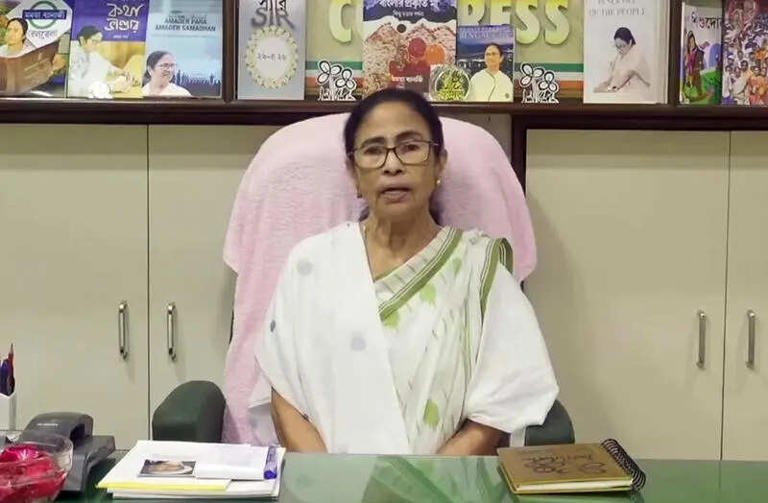
West Bengal Chief Minister Mamata Banerjee came out in support of hawkers and criticised the BJP government over what she described as “oppression” and demolition actions affecting small traders and informal workers.
Addressing the issue publicly, Banerjee accused the BJP of adopting policies that place pressure on vulnerable sections and alleged that demolition drives and administrative actions were creating uncertainty among people dependent on small businesses and roadside trade.
Her remarks have added a political dimension to the ongoing discussion surrounding urban management, public spaces, and livelihood concerns.
Mamata Banerjee Extends Support To Hawkers
Speaking on the issue, Mamata Banerjee said her government stands with hawkers and supports the right of people to earn their livelihood through lawful economic activity.
She stated that informal workers and small traders contribute significantly to local economies and should not face unnecessary pressure.
According to Banerjee, public policy should balance development priorities with protection of livelihoods.
She argued that people dependent on small-scale trade require support and practical solutions rather than sudden action.
The chief minister also emphasised that economic activity at the grassroots level remains important for local communities and household income.
Her comments reflected the Trinamool Congress government’s continued emphasis on welfare and livelihood-related issues.
Chief Minister Criticises Demolition Actions
During her remarks, Banerjee criticised demolition drives and alleged that such actions were creating hardship for ordinary people.
She claimed that administrative measures should consider social and economic consequences before implementation.
According to Banerjee, governments should adopt approaches that reduce disruption and create opportunities for rehabilitation where necessary.
She argued that development initiatives should not overlook people who depend on small business activities for daily income.
The chief minister also alleged that the BJP’s approach placed excessive emphasis on enforcement without adequate consideration for affected groups.
Her remarks triggered political discussion over governance and public policy approaches.
Political Debate Intensifies Over Urban Administration
The comments from Mamata Banerjee have intensified debate around urban governance, encroachment policies, and economic protection.
Supporters of stricter enforcement often argue that administrative action remains necessary to maintain public spaces and improve infrastructure.
At the same time, supporters of hawkers argue that policy decisions should recognise the realities of informal employment.
Observers noted that issues related to hawkers and public spaces frequently become politically sensitive because they involve both livelihood and governance concerns.
The latest exchange once again brought attention to how governments balance regulation and economic inclusion.
Political parties continue to present differing approaches on the issue.
Hawkers Remain Important Part Of Local Economy
Street vendors and hawkers continue to play an important role in economic activity across urban and semi-urban areas.
They provide goods and services while creating employment opportunities and supporting local markets.
Policy discussions around hawkers often focus on balancing economic inclusion with public planning requirements.
Experts note that urban administration increasingly requires models that accommodate both development and livelihood needs.
Banerjee highlighted the role of small traders and argued that governance should remain sensitive to people working in informal sectors.
The discussion also reflected broader concerns regarding employment and economic resilience.
Livelihood Protection Emerges As Key Political Theme
The latest remarks from Mamata Banerjee reinforced livelihood protection as an important political issue.
The chief minister argued that governments should ensure that economic opportunities remain available for people dependent on small-scale business activity.
According to her, policy decisions should focus on both regulation and social protection.
Political observers noted that welfare and livelihood issues continue to shape political narratives in West Bengal.
Supporters of the government’s position argue that economic support and inclusive approaches remain necessary.
Others maintain that urban regulation and infrastructure development also require effective enforcement.
The debate therefore continues to remain active across political and public platforms.
Focus Turns To Policy And Administrative Response
Following Banerjee’s comments, attention is expected to remain on how governments approach issues related to hawkers, public spaces, and administrative action.
Observers believe the discussion may continue as political parties articulate different approaches toward development and livelihood concerns.
The issue has once again highlighted the challenge of balancing governance objectives with economic realities.
Mamata Banerjee’s remarks placed strong emphasis on protecting small traders and opposing what she described as pressure on vulnerable sections.
As political debate continues, the conversation around hawkers, urban management, and livelihood protection is expected to remain an important subject in West Bengal’s public discourse.