

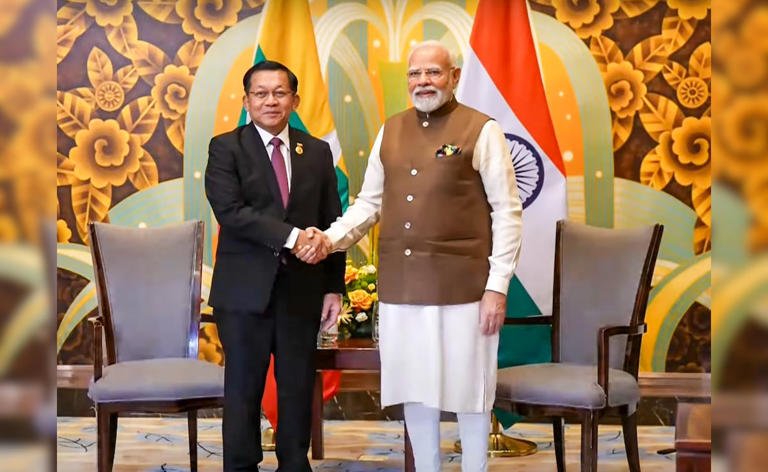
Myanmar’s President is set to visit India for a high-level diplomatic engagement aimed at strengthening bilateral relations, with trade, defence cooperation, connectivity, and regional security expected to dominate discussions. The visit comes at a time when both countries are seeking to deepen cooperation across strategic and economic sectors while addressing shared challenges in the region.
Officials from both sides are expected to hold extensive discussions on enhancing economic partnerships, boosting cross-border trade, improving connectivity projects, and strengthening security cooperation along the India-Myanmar border.
The upcoming visit underscores the importance of Myanmar in India’s Act East Policy and highlights New Delhi’s continued efforts to strengthen engagement with its eastern neighbor.
High-Level Visit to Strengthen Bilateral Ties
The visit is expected to provide an important opportunity for leaders from both countries to review the status of bilateral relations and identify new areas for cooperation.
India and Myanmar share deep historical, cultural, and geographical connections. The two countries also maintain a strategic partnership that spans multiple sectors, including trade, infrastructure, security, energy, and people-to-people exchanges.
Officials believe the visit will help accelerate ongoing initiatives and strengthen political engagement at the highest level.
The discussions are expected to reaffirm the commitment of both nations to maintaining strong diplomatic relations and promoting regional stability.
Analysts note that regular high-level interactions play an important role in sustaining momentum in bilateral partnerships.
Trade Cooperation Expected to Take Centre Stage
Economic cooperation is likely to be one of the primary themes of the visit. India and Myanmar have steadily expanded trade relations over the years, with both countries recognizing the potential for further growth.
Officials are expected to discuss measures to facilitate trade, improve market access, and strengthen commercial links between businesses in the two countries.
Border trade remains particularly important because of the long land boundary shared by India and Myanmar. Enhanced trade connectivity can contribute to economic growth while supporting local communities on both sides of the border.
The leaders may also explore opportunities for cooperation in agriculture, manufacturing, pharmaceuticals, energy, and digital services.
Economic experts believe stronger trade ties can create mutual benefits and support broader regional development goals.
Focus on Defence and Security Cooperation
Defence cooperation is expected to be another key agenda item during the visit. India and Myanmar have maintained close security cooperation, particularly in addressing cross-border challenges and promoting stability in border regions.
Officials are likely to discuss mechanisms for strengthening coordination between security agencies and enhancing cooperation on matters of mutual concern.
The two countries share a long and sensitive border that requires regular coordination to address issues related to security and border management.
Defence engagement may also include discussions on training, capacity-building initiatives, and military-to-military exchanges.
Analysts note that security cooperation remains an important pillar of the India-Myanmar relationship due to shared regional interests and geographical proximity.
Connectivity Projects Under Review
Connectivity has emerged as a major area of cooperation between India and Myanmar. Several infrastructure projects are aimed at improving transportation links and facilitating trade between the two countries and the broader Southeast Asian region.
During the visit, leaders are expected to review progress on ongoing connectivity initiatives and discuss ways to accelerate implementation.
Improved road, port, and transport infrastructure can significantly enhance economic integration and support regional commerce.
Officials believe connectivity projects are essential for realizing the objectives of India’s Act East Policy while promoting development in the northeastern states.
Enhanced connectivity can also strengthen cultural and people-to-people ties between neighboring communities.
Importance for India’s Act East Policy
Myanmar occupies a strategic position in India’s Act East Policy because it serves as a gateway connecting South Asia and Southeast Asia.
Indian policymakers view stronger relations with Myanmar as essential for expanding economic engagement with the Association of Southeast Asian Nations (ASEAN) and promoting regional integration.
The upcoming visit is expected to reinforce this strategic vision by advancing cooperation in areas that contribute to connectivity, trade, and security.
Experts note that Myanmar’s geographical location gives it significant importance in regional economic and geopolitical calculations.
Consequently, strengthening bilateral ties remains a priority for both countries.
Cooperation in Border Development
Border development initiatives are also expected to feature in the discussions. Communities living along the India-Myanmar border often face challenges related to infrastructure, connectivity, healthcare, and economic opportunities.
Officials from both countries have previously emphasized the importance of improving conditions in border regions through coordinated development efforts.
The leaders may explore ways to strengthen cooperation on infrastructure projects, trade facilitation, and community welfare programmes.
Such initiatives can contribute to stability while creating economic opportunities for local populations.
Observers believe development-focused cooperation can help strengthen trust and improve bilateral relations at the grassroots level.
Regional Stability and Strategic Interests
Regional security developments are likely to be discussed during the visit. Both countries share an interest in maintaining peace, stability, and economic growth across the region.
Officials may exchange views on evolving geopolitical developments and opportunities for regional cooperation.
India and Myanmar have frequently worked together on issues related to connectivity, economic integration, and security. The visit provides an opportunity to reaffirm these shared interests and strengthen collaboration.
Political analysts note that regional stability remains essential for sustaining economic growth and attracting investment.
The discussions are therefore expected to address both bilateral and broader regional priorities.
Expanding People-to-People Connections
Apart from trade and defence, the visit may also focus on enhancing cultural and educational exchanges between the two countries.
India and Myanmar share centuries-old civilizational links rooted in religion, culture, and historical interactions. These connections continue to serve as an important foundation for bilateral relations.
Officials believe greater educational cooperation, tourism exchanges, and cultural initiatives can strengthen mutual understanding and goodwill.
People-to-people ties often complement diplomatic and economic engagement by fostering stronger relationships between societies.
The leaders are expected to highlight the importance of these connections during the visit.
Looking Ahead
The upcoming visit of Myanmar’s President to India is expected to provide fresh momentum to bilateral relations at a time of growing regional significance. With trade, defence cooperation, connectivity, and border development high on the agenda, both countries are likely to focus on expanding practical cooperation and strengthening strategic ties.
The discussions will reflect the importance of Myanmar in India’s Act East Policy and underscore the shared commitment of both nations to regional stability and economic development. Enhanced cooperation in trade and security could create new opportunities while addressing common challenges.
As leaders prepare for the high-level engagement, observers will closely watch the outcomes of the discussions and any agreements that emerge. The visit is expected to reinforce the longstanding partnership between India and Myanmar and contribute to stronger cooperation in the years ahead.