

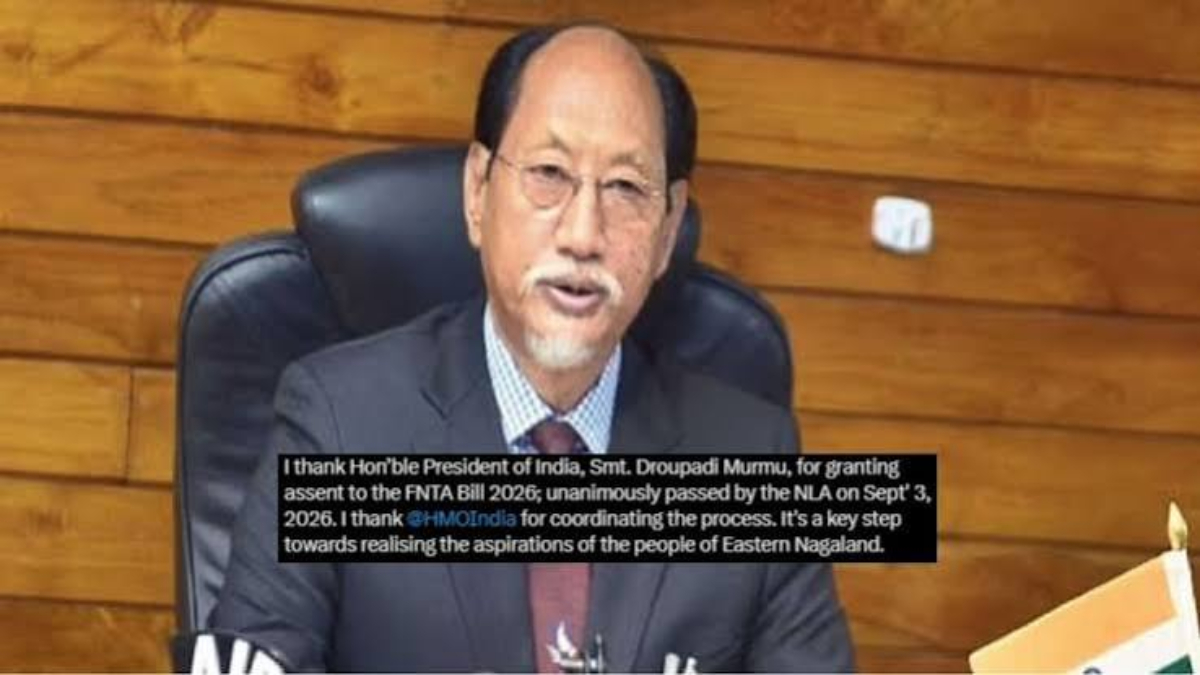
President Droupadi Murmu has granted assent to the FNTA Bill 2026, marking a major step towards greater administrative autonomy for Eastern Nagaland. Nagaland Chief Minister Neiphiu Rio welcomed the development, describing it as an important milestone in addressing the long-standing aspirations of people in the state’s six eastern districts. The legislation aims to strengthen decentralised governance, improve development opportunities and give local communities a greater role in regional administration.
FNTA Bill 2026 Receives Presidential Assent
The President’s assent was announced by Chief Minister Neiphiu Rio on October 25, 2026, through a post on social media platform X. Rio thanked President Murmu for approving the legislation and acknowledged the Union Ministry of Home Affairs for coordinating the process.
The Nagaland Legislative Assembly had unanimously passed the revised bill on September 3, 2026, bringing the proposed autonomous authority closer to implementation.
Rio said the development represented a key step towards fulfilling the aspirations of Eastern Nagaland’s people. Deputy Chief Minister Yanthungo Patton also welcomed the approval, describing it as a historic milestone for the region.
The presidential assent completes an important stage in the legislative process. However, the authority’s actual functioning will depend on the state government’s implementation measures and the formal notification bringing the Act into force.
Six Eastern Nagaland Districts to Come Under FNTA
The proposed Frontier Nagaland Territorial Authority will cover six districts: Tuensang, Mon, Longleng, Kiphire, Noklak and Shamator.
These districts have long raised concerns about developmental inequalities, geographical challenges and limited access to public services. The new administrative arrangement is intended to address these issues by strengthening regional decision-making and enabling more focused development planning.
Under the legislation, the authority will exercise powers over 46 subjects, providing a framework for greater local involvement in governance and administration. The transferred responsibilities are expected to cover important areas of public administration and development, including agriculture, education, health, rural development and tourism.
The initiative seeks to ensure that local priorities receive greater attention while maintaining the region’s position within Nagaland.
FNTA Bill 2026: Structure and Representation
The proposed authority will have a 62-member structure, combining elected representation with other designated members.
It will include 40 directly elected representatives from territorial constituencies. One-third of these elected seats will be reserved for women, creating a formal provision for greater women’s participation in regional governance.
Twenty legislators representing constituencies within the Frontier Nagaland Territory will serve as ex-officio members without voting rights. The remaining two members will be nominated by the Governor, with provisions intended to represent recognised tribes that are unrepresented or under-represented.
The authority’s executive functions will be handled by an Executive Council headed by a Chief Executive Member. This structure is intended to support administrative coordination and enable the authority to address regional priorities through an institutional framework.
The legislation also provides for an interim council during the transition towards an elected authority. The interim arrangement can operate for up to one year or until the first elected FNTA is constituted, whichever comes earlier.
Agreement with ENPO Led to the Autonomy Framework
The development follows a memorandum of agreement signed on February 5, 2026, by the Government of India, the Nagaland government and the Eastern Nagaland Peoples’ Organisation (ENPO).
The agreement emerged after years of discussions over the demand for a separate state for Eastern Nagaland. The ENPO has pursued this demand since 2010, citing developmental disparities and the need for stronger political and administrative representation.
The FNTA framework offers an alternative arrangement intended to address these concerns through decentralised self-governance within Nagaland rather than creating a separate state.
The legislative process encountered difficulties earlier in 2026. An initial version of the bill introduced in March was withdrawn after the Centre, the ENPO and the Eastern Nagaland Legislators’ Union sought greater clarity on certain provisions. A revised version was subsequently introduced in September and passed unanimously by the Assembly.
Constitutional Safeguards and Next Steps
The legislation provides for the continuation of existing protections associated with Article 371A of the Constitution, alongside the Bengal Eastern Frontier Regulation of 1873 and the region’s exemption from the Panchayati Raj system.
These safeguards remain important to Nagaland’s distinctive constitutional and customary framework. The new authority is designed to expand regional administration without removing these existing protections.
The state government must now proceed with the necessary formalities, including notifying the date on which the Act will come into force. The transitional council and subsequent constitution of the elected authority will be important steps in establishing the new system.
For Eastern Nagaland, the presidential assent creates an opportunity to translate years of negotiations into a functioning administrative arrangement. Its success will ultimately depend on effective implementation, adequate funding, coordination between governments and the authority’s ability to deliver tangible improvements in education, healthcare, infrastructure and livelihoods across the six districts.
Assam Rifles Drives Fitness Push with Fit India Freedom Run 7.0 in Agartala and Lokra