

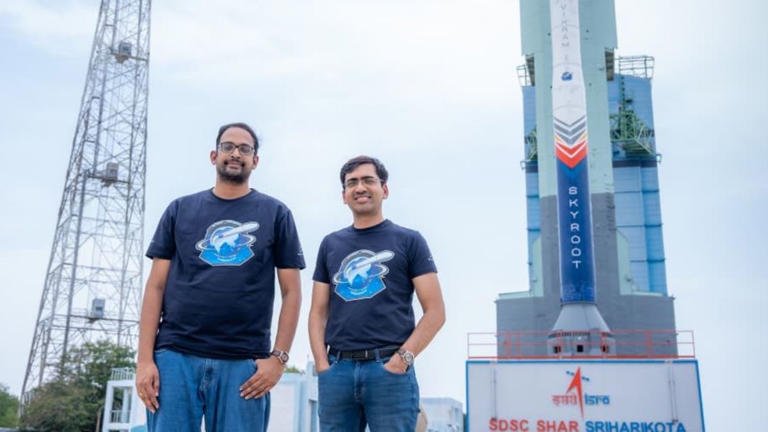
In a landmark achievement for India’s private space industry, Skyroot Aerospace, founded by former ISRO scientists Pawan Kumar Chandana and Naga Bharath Daka, successfully launched Vikram-1, the country’s first privately developed orbital rocket. What began as a bold entrepreneurial dream after leaving secure government jobs has now transformed into a USD 1.1 billion space-tech unicorn, placing India among a select group of nations capable of launching privately built orbital rockets.
The successful Mission Aagaman not only demonstrated Skyroot’s technological capabilities but also marked a new era for India’s commercial space ambitions. The launch showcased how private innovation, supported by India’s space sector reforms, is reshaping the country’s position in the global space economy.
From ISRO Scientists to Startup Founders
Pawan Kumar Chandana and Naga Bharath Daka spent several years working at the Indian Space Research Organisation (ISRO), contributing to India’s launch vehicle programmes. Inspired by the potential of private participation in space technology, the duo left their government careers in 2018 to establish Skyroot Aerospace in Hyderabad.
Their vision was to create affordable, reliable, and dedicated launch services for the rapidly growing global small satellite market. At a time when India’s space sector was largely dominated by ISRO, their decision was considered both ambitious and risky.
Building India’s First Space-Tech Unicorn
Over the past eight years, Skyroot has evolved from a small startup into India’s first space-tech unicorn, achieving a valuation of approximately USD 1.1 billion after successive funding rounds backed by leading domestic and international investors.
The company has developed advanced launch vehicle technologies, including solid rocket motors, carbon-composite structures, avionics, and 3D-printed rocket engines. Its rapid growth reflects increasing investor confidence in India’s expanding private space ecosystem.
Historic Success of Vikram-1
The company’s biggest milestone came with the successful launch of Vikram-1 from the Satish Dhawan Space Centre in Sriharikota. The 22-metre-tall launch vehicle successfully carried multiple commercial and technology demonstration payloads into a 450-kilometre low-Earth orbit, making it India’s first privately built orbital rocket to achieve orbit.
The mission validated several critical technologies, including propulsion systems, avionics, telemetry, guidance, navigation, and flight control systems. Skyroot described the mission as a successful technology demonstration that will pave the way for future commercial launches.
Mission Aagaman Opens Commercial Opportunities
Named Mission Aagaman, the maiden orbital flight is expected to serve as the foundation for Skyroot’s commercial launch business. The company plans to conduct additional developmental flights before beginning routine commercial missions for domestic and international satellite operators.
Vikram-1 has been designed to carry payloads of up to 350 kilograms into low-Earth orbit, targeting the rapidly growing global market for small satellite launches.
Innovation at the Core
Skyroot has focused heavily on innovation to reduce launch costs and improve operational efficiency. Vikram-1 incorporates three solid-fuel stages and a restartable liquid-fuel orbital adjustment module powered by a 3D-printed engine, one of the first such technologies to be flown in India.
The company has also invested in lightweight carbon-composite structures, rapid manufacturing techniques, and modular rocket architecture to make launches faster and more cost-effective.
A Boost for India’s Private Space Sector
Skyroot’s success follows the Indian government’s decision to open the space sector to private participation in 2020. The reforms enabled startups to build rockets, satellites, and launch services while gaining access to ISRO’s testing facilities and technical expertise.
The successful Vikram-1 mission is expected to encourage greater investment in India’s private aerospace sector and strengthen the country’s competitiveness in the global commercial launch market. The government aims to increase India’s share of the global space economy from around USD 8 billion to USD 44 billion by 2033.
Inspiring a New Generation
The journey of Chandana and Daka has become an inspiration for aspiring entrepreneurs and engineers across the country. Pawan Kumar Chandana’s story is particularly remarkable, having overcome academic struggles before studying at IIT Kharagpur, joining ISRO, and eventually co-founding one of India’s most successful space startups.
Their success demonstrates how innovation, perseverance, and entrepreneurship can create globally competitive technology companies from India.
A New Chapter in India’s Space Journey
The launch of Vikram-1 represents much more than the success of a single company—it marks the beginning of a new era for India’s private space industry. By leaving ISRO to pursue their entrepreneurial vision, Pawan Kumar Chandana and Naga Bharath Daka have helped redefine India’s role in the global space sector.
With Skyroot Aerospace now valued at USD 1.1 billion and its first orbital mission successfully completed, the company is poised to become a major player in the international launch market. The success of Vikram-1 not only strengthens India’s commercial space ambitions but also highlights how private innovation is complementing the country’s long-standing achievements in space exploration, paving the way for a more competitive and technology-driven future.