

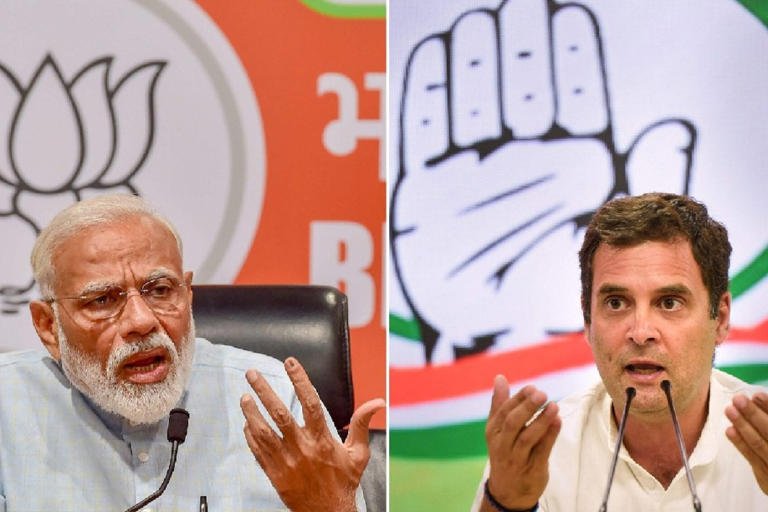
Rahul Gandhi intensified his attack on Narendra Modi by drawing comparisons with the demonetisation period and claiming that the Prime Minister would eventually “cry on TV” like during the note ban announcement.
The remarks triggered a sharp political response from the Bharatiya Janata Party, which accused Rahul Gandhi of making irresponsible and politically motivated statements against the Prime Minister.
The Congress leader’s comments came during a political address in which he criticised the BJP-led central government over economic issues, governance decisions, and its handling of national challenges.
Soon after the statement surfaced publicly, BJP leaders launched a strong counterattack and accused Rahul Gandhi of insulting the Prime Minister repeatedly for political gain.
The exchange once again highlighted the growing intensity of political confrontation between the Congress and the BJP ahead of upcoming political campaigns and electoral battles.
Rahul Gandhi targets PM Modi
During his speech, Rahul Gandhi sharply criticised Prime Minister Narendra Modi and referred to the 2016 demonetisation exercise while attacking the BJP government’s economic policies.
The Congress leader claimed that the Prime Minister would face political and public pressure similar to the note ban period and eventually appear emotional before the nation.
Rahul Gandhi also questioned the government’s handling of economic and social issues during his address.
The Congress has repeatedly criticised demonetisation over the years, describing the move as economically damaging and harmful to small businesses, workers, and ordinary citizens.
Political observers noted that Rahul Gandhi continues using economic issues and past government decisions as central themes in his criticism of the BJP leadership.
His latest remarks quickly became a major political talking point across television debates and social media platforms.
BJP launches sharp counterattack
The BJP strongly criticised Rahul Gandhi’s remarks and accused him of making disrespectful and politically irresponsible statements against the Prime Minister.
Several BJP leaders defended Narendra Modi and stated that the Congress leader was attempting to gain political attention through provocative comments.
Party representatives also argued that Rahul Gandhi repeatedly insults constitutional institutions and elected leadership for political mileage.
Some BJP leaders accused the Congress of spreading negativity instead of presenting constructive alternatives on governance and development issues.
The ruling party also highlighted Modi’s political popularity and electoral record while dismissing Rahul Gandhi’s criticism as politically motivated rhetoric.
Observers noted that personal political attacks have increasingly become a major feature of contemporary political discourse in India.
Demonetisation remains political flashpoint
Demonetisation continues remaining one of the most debated political and economic decisions taken during Narendra Modi’s tenure as Prime Minister.
The BJP has defended the policy as an important step against black money, counterfeit currency, and corruption.
Meanwhile, opposition parties, including the Congress, have consistently criticised the decision and blamed it for economic disruption and hardship faced by ordinary citizens.
Rahul Gandhi has repeatedly targeted the BJP government over demonetisation during election campaigns, parliamentary speeches, and public rallies.
Political analysts noted that the issue still carries strong emotional and political significance because of its nationwide impact.
The latest remarks therefore revived discussions surrounding the long-term effects and political legacy of demonetisation.
Congress intensifies attack on BJP
The Congress has recently intensified its political attacks on the BJP government over economic management, unemployment, inflation, and governance-related issues.
Rahul Gandhi has frequently criticised the Modi government during public meetings and political campaigns across different states.
Congress leaders argue that the BJP government focuses more on political messaging than addressing economic concerns faced by citizens.
The opposition party has also attempted to position itself as a stronger alternative by highlighting issues linked to jobs, social welfare, and democratic institutions.
Observers noted that Rahul Gandhi’s aggressive political tone reflects the Congress party’s attempt to strengthen its national opposition narrative.
The latest remarks against Modi therefore formed part of a broader political strategy by the Congress leadership.
BJP highlights Modi’s leadership record
In response to Rahul Gandhi’s comments, BJP leaders praised Prime Minister Narendra Modi’s leadership and governance record.
Party representatives highlighted achievements related to infrastructure, welfare schemes, digital governance, foreign policy, and economic reforms.
The BJP also accused the Congress of failing to accept political realities and repeatedly resorting to personal attacks against Modi.
Several BJP leaders argued that the Prime Minister continues enjoying strong public support because of his governance model and political leadership.
Observers noted that the BJP often responds to opposition criticism by projecting Modi as a decisive and development-oriented leader.
The ruling party also intensified its online campaign after Rahul Gandhi’s statement gained traction on social media.
Social media amplifies political clash
The political exchange quickly spread across social media platforms, where supporters of both parties engaged in heated debates.
Congress supporters defended Rahul Gandhi’s remarks and used the opportunity to criticise demonetisation and other government policies.
Meanwhile, BJP supporters accused Rahul Gandhi of disrespecting the Prime Minister and lowering the level of political discourse.
Political hashtags linked to the controversy trended across multiple digital platforms as videos and speech clips circulated widely online.
Observers noted that social media now plays a major role in shaping political narratives and amplifying political confrontations.
The latest controversy once again demonstrated how rapidly political speeches can dominate national discussions through digital platforms.
Political rhetoric intensifies ahead of campaigns
Political analysts believe the sharp exchange between Rahul Gandhi and BJP leaders reflects intensifying political rhetoric ahead of future electoral contests.
Both the Congress and BJP have increasingly adopted aggressive political communication strategies in recent months.
Observers noted that opposition parties are attempting to challenge Modi’s leadership directly, while the BJP continues defending its governance and political record strongly.
The use of strong language and symbolic comparisons has become common in high-profile political speeches across India.
Analysts also pointed out that personal political attacks often energise party supporters but may also deepen political polarisation.
The latest exchange therefore reflects the broader confrontational atmosphere dominating national politics.
Opposition and ruling party continue confrontation
The confrontation between Rahul Gandhi and the BJP leadership highlights the continuing political rivalry between the Congress and the ruling party.
While Rahul Gandhi continues targeting the Modi government over economic and governance issues, the BJP remains focused on defending Modi’s leadership and attacking the Congress politically.
Political observers believe such exchanges are likely to continue as parties prepare for upcoming campaigns and political battles across the country.
The debate over demonetisation and governance issues also remains politically relevant because opposition parties continue using it to criticise the BJP government.
As political rhetoric sharpens further, both the Congress and BJP are expected to intensify their campaigns through speeches, public outreach, and social media messaging in the coming months.