

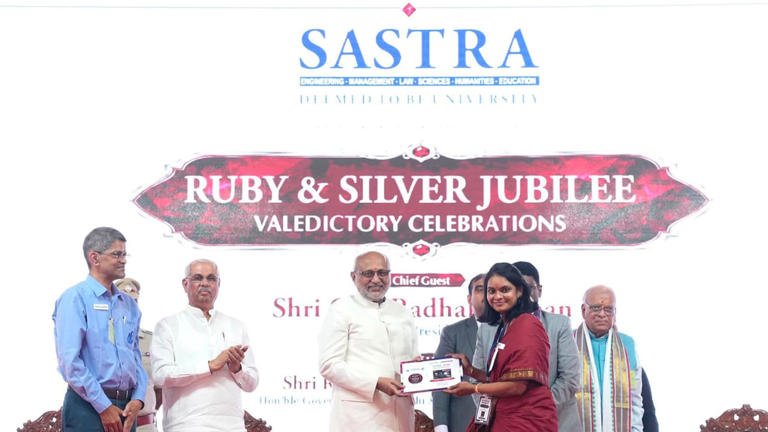
SASTRA Deemed University in Thanjavur has received praise for its contribution to higher education, academic excellence and research at a special jubilee event. The occasion brought together university leaders, academics, students and distinguished guests to celebrate the institution’s achievements and reflect on its journey in the field of education.
The event highlighted SASTRA’s growing role in India’s higher education landscape. Speakers praised the university for combining academic learning with research, innovation, technology and professional development.
The institution has built a strong reputation over the years through its programmes in engineering, sciences, law, management, humanities and education. SASTRA currently holds an A++ accreditation from the National Assessment and Accreditation Council (NAAC) and enjoys Category-I status under the University Grants Commission’s graded autonomy framework.
SASTRA’s Academic Journey Receives Recognition
The jubilee celebration provided an opportunity to look back at SASTRA’s academic journey and its contribution to higher education.
The university began its journey in 1984 and has gradually expanded into a comprehensive institution offering undergraduate, postgraduate and doctoral programmes. Its academic activities now cover several disciplines, including engineering, science, management, law and education.
The institution has also developed a strong research culture. Faculty members and students participate in research projects, consultancy activities and collaborations with industry and other academic institutions.
SASTRA’s leadership has consistently emphasised merit, transparency and quality education as important pillars of its academic model. (sastra.edu)
Vice President Highlights Role of Higher Education
The Vice President’s participation added significance to the jubilee event. The address focused attention on the role universities can play in shaping India’s future.
Higher education institutions now face a rapidly changing environment. Artificial intelligence, emerging technologies, new employment models and global competition are changing the skills that students need.
Universities therefore need to prepare students for more than examinations. They must develop critical thinking, creativity, communication skills and the ability to solve real-world problems.
The event provided an opportunity to discuss these priorities while celebrating SASTRA’s achievements.
Research and Innovation Remain Key Priorities
Research has become an important part of SASTRA’s academic identity.
The university supports research in areas ranging from engineering and computing to sciences, medicine, law and humanities. It has also developed specialised laboratories and research centres to support advanced work.
SASTRA’s School of Computing, for example, operates advanced facilities for research and development in computer science and information technology. Its infrastructure includes high-performance computing facilities and specialised laboratories.
The university has also strengthened its partnerships with industries and other academic institutions.
These collaborations can help students and researchers work on practical problems while giving industry access to academic expertise.
Strong Industry-Academia Connections
SASTRA has increasingly focused on connecting education with industry requirements.
In March 2026, the university hosted the SASTRA PACT for IMPACT event, where it signed several agreements with organisations including Zoho Corporation, City Union Bank, Centific, IIT Ropar, Greaves Cotton, PRODAPT and nStore.
The partnerships cover areas such as artificial intelligence, agriculture sustainability, software engineering, advanced manufacturing and mathematical modelling.
Such collaborations can provide students with opportunities to work on industry-oriented projects and gain practical experience.
They can also strengthen research partnerships and encourage the development of new technologies.
Focus on Technology and Artificial Intelligence
Artificial intelligence has become a major area of focus for SASTRA.
The university has organised programmes and collaborations aimed at exploring the opportunities created by AI. It has also encouraged students to develop skills in emerging technologies.
The changing technology landscape makes this increasingly important. Employers across sectors now seek graduates who can understand digital tools and apply them to practical problems.
Universities therefore have a responsibility to ensure that students receive both theoretical knowledge and hands-on experience.
SASTRA’s emphasis on technology and research reflects this changing requirement.
Preparing Students for the Future
Academic excellence extends beyond examination results. Universities must prepare students to adapt to changing professional environments.
SASTRA offers programmes across several disciplines and provides students with access to laboratories, research facilities, industry interactions and extracurricular activities.
The university says its academic environment aims to encourage intellectual curiosity and professional development. Its leadership also highlights the importance of values and ethics in student development.
This broader approach can help students develop skills that remain useful even as industries and technologies change.
Importance of Innovation in Higher Education
The jubilee event also underlined the importance of innovation in India’s higher education sector.
Universities have an important role in developing new ideas and technologies. They can provide young researchers with the facilities and mentorship needed to transform ideas into practical solutions.
SASTRA has established innovation and entrepreneurship initiatives as part of its wider academic ecosystem.
The university’s planning and monitoring structure also focuses on areas such as internationalisation, innovation, entrepreneurship, industrial collaboration and academic reforms.
These priorities can help institutions remain relevant in a rapidly changing educational environment.
SASTRA’s Contribution to Thanjavur
SASTRA’s presence has also strengthened Thanjavur’s position as an important educational centre.
Located at Tirumalaisamudram, the university attracts students from different parts of India. Its large campus includes academic buildings, laboratories, research facilities and student amenities.
The institution’s growth has contributed to the wider educational ecosystem of the region.
It has also created opportunities for students to pursue specialised programmes without moving to larger metropolitan cities.
Academic Excellence Backed by Accreditation
SASTRA’s academic reputation has received recognition through national accreditation and institutional rankings.
The university has been re-accredited by NAAC with an A++ grade, the highest accreditation category. It also holds Category-I university status under UGC regulations.
Several of its engineering programmes have also received international accreditation from the Institution of Engineering and Technology in the United Kingdom.
These recognitions provide external benchmarks for the quality of the university’s academic programmes.
Students Remain at the Centre
The university’s academic achievements ultimately depend on its students and faculty.
SASTRA has a large student population across its different schools and programmes. Faculty members contribute through teaching, research, mentoring and academic administration.
The university also encourages students to participate in technical competitions, cultural programmes, sports and community initiatives.
Such activities can help students develop leadership, teamwork and communication skills alongside academic knowledge.
Looking Towards the Future
The jubilee event comes at a time when India’s higher education sector is undergoing significant changes.
The National Education Policy 2020 has encouraged multidisciplinary education, research, innovation and greater links between universities and industry.
Institutions such as SASTRA will play an important role in implementing these priorities.
The university’s existing focus on research, technology, industry collaboration and multidisciplinary programmes gives it a strong foundation for adapting to these changes.
Its partnerships with Indian and international institutions can also help expand opportunities for students and researchers.
SASTRA’s Legacy Continues
The recognition of SASTRA academic excellence 2026 at the Thanjavur jubilee event highlights the university’s evolution into a prominent higher education institution.
From its beginnings in 1984, SASTRA has expanded its academic programmes, research activities and institutional partnerships. Its A++ NAAC accreditation and Category-I status further underline its standing in India’s higher education sector.
The Vice President’s praise at the jubilee event also reinforces the importance of institutions that combine academic excellence with innovation and social responsibility.
As technology continues to transform education and employment, universities will need to prepare students for careers that may look very different from those of today.
SASTRA’s emphasis on research, industry collaboration, emerging technologies and holistic student development positions it to remain an important part of that transformation.
The jubilee celebration was therefore not only a recognition of the university’s past achievements. It also offered an opportunity to look ahead and consider how SASTRA can continue contributing to India’s knowledge economy, technological progress and higher education system.