

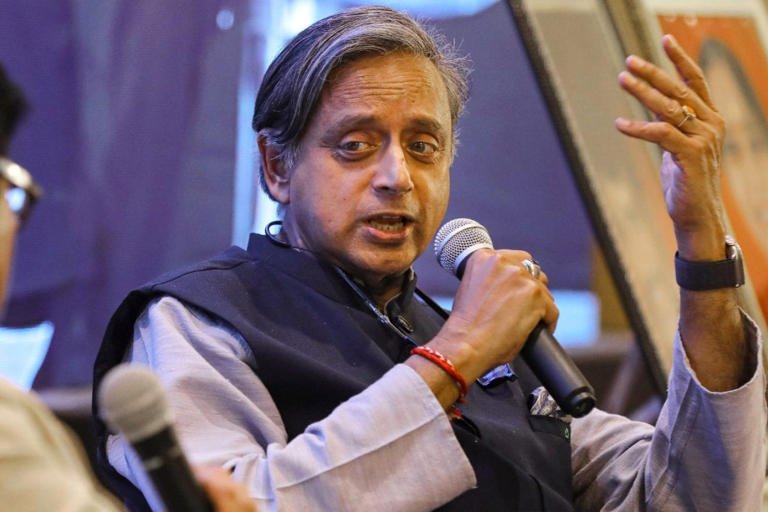
Congress MP Shashi Tharoor has criticised the new Parliament building, describing it as “soulless” and arguing that its seating arrangement reflects the growing political polarisation in Indian politics. His remarks have triggered fresh debate over the architecture, symbolism and political meaning associated with the new complex.
Tharoor compared the new Parliament building with the old structure and said that the earlier building had a different character and atmosphere. According to him, the older Parliament House encouraged a greater sense of connection among members, while the design of the new complex has created a more formal and divided environment.
The Congress leader also linked the physical layout of the House to the present political climate. He suggested that the arrangement of members reflects the increasing distance between political parties and the sharp divisions that have emerged in public and parliamentary debates.
Tharoor’s comments have added another dimension to the continuing discussion surrounding the new Parliament building, which replaced the historic Parliament House as the main venue for India’s legislative proceedings.
Shashi Tharoor Questions the Character of the New Parliament Building
Shashi Tharoor said that he found the new Parliament building lacking in the character and warmth associated with the old structure.
The new complex was designed to meet modern requirements and provide greater capacity for Members of Parliament. It also includes improved facilities and infrastructure intended to support the functioning of the legislature in the coming decades.
However, Tharoor’s criticism focused less on these practical aspects and more on the building’s atmosphere.
He described the new structure as “soulless,” suggesting that architecture can influence how people experience an institution.
For Tharoor, Parliament is not simply a workplace for elected representatives. It is also a historic democratic space where members debate, disagree and interact with one another.
His remarks suggest that he believes the old Parliament building created a stronger sense of continuity with India’s democratic history.
Old Parliament Building Had a Different Atmosphere
The old Parliament House served as the centre of India’s parliamentary democracy for decades.
Its circular design and historic architecture became closely associated with major political debates and decisions.
Several important events in independent India’s history unfolded within its chambers.
Tharoor argued that the older building had a distinctive atmosphere that the new complex does not recreate.
The physical design of a political institution can influence how people move and interact within it.
Informal conversations and meetings between members of different political parties can sometimes play an important role in parliamentary functioning.
Tharoor suggested that the older structure created more opportunities for such interaction.
The new building, in his view, represents a different and more formal environment.
Seating Layout and Political Polarisation
A major part of Tharoor’s criticism focused on the seating arrangement inside the new Parliament building.
He argued that the layout visually reflects India’s growing political polarisation.
The ruling party and the opposition occupy clearly defined sections, creating a physical separation that, according to Tharoor, mirrors the wider divisions in Indian politics.
Political polarisation has become an important subject of debate in recent years.
Sharp disagreements between political parties have often dominated parliamentary sessions and public discussions.
The Congress and the BJP have frequently clashed over issues ranging from government policy to democratic institutions.
Tharoor’s observation suggests that the design of the House can symbolically reinforce these divisions.
While the layout itself serves practical and organisational purposes, he argued that its appearance reflects the broader political atmosphere.
Parliament as a Space for Dialogue
Parliament plays a central role in India’s democratic system.
It is a place where representatives debate legislation, question the government and raise issues affecting their constituencies.
However, the functioning of Parliament also depends on communication between political parties.
Members may strongly disagree during formal debates, but dialogue outside the House can sometimes help resolve disagreements and build consensus.
Tharoor’s remarks highlighted the importance of preserving opportunities for interaction.
He suggested that the design of parliamentary spaces should not only focus on efficiency and capacity but also consider the human relationships that shape democratic institutions.
The new Parliament building was constructed to meet future requirements, but critics like Tharoor have raised questions about whether modern functionality can fully replace the historical character of the old complex.
A Debate Over Architecture and Symbolism
The debate surrounding the new Parliament building is also a debate about symbolism.
Public buildings often represent more than their physical structure.
Parliament, in particular, carries a strong symbolic connection with democracy and national identity.
Supporters of the new complex have highlighted its modern facilities, larger capacity and design features.
They argue that India needed a new parliamentary complex capable of meeting the country’s future requirements.
Critics, however, have expressed concerns about the loss of the old building’s historic character.
Tharoor’s description of the structure as “soulless” reflects this emotional and symbolic criticism.
The debate shows how architecture can become connected with larger political and cultural questions.
The Need for a Modern Parliament Complex
The new Parliament building was developed as part of a wider effort to modernise India’s central administrative infrastructure.
The new complex provides more space and facilities for Members of Parliament.
As India’s population and representation requirements grow, Parliament needs infrastructure capable of accommodating future changes.
The building also incorporates modern technology and security systems.
Supporters argue that the old structure, despite its historical importance, was not designed to meet every requirement of a modern legislature.
From this perspective, the new Parliament building represents an investment in India’s future.
However, Tharoor’s criticism does not necessarily focus on whether Parliament required better infrastructure.
Instead, his remarks raise questions about whether a modern building can also retain a sense of historical identity and human connection.
Political Polarisation Beyond the Building
Tharoor’s comments also point to a larger concern about political polarisation in India.
The divisions between political parties have become increasingly visible in Parliament and outside it.
Debates often involve sharp exchanges, protests and disruptions.
Political disagreement is a natural part of democracy. However, excessive polarisation can make it more difficult for parties to find common ground.
Tharoor used the seating arrangement of the new Parliament building as a metaphor for this wider political environment.
The physical separation between political groups, he suggested, mirrors the ideological and political distance that has developed between them.
Whether architecture directly influences political behaviour remains open to debate.
However, the design of public institutions can shape how people interact and experience shared spaces.
Opposition and Government Remain Sharply Divided
The relationship between the government and the opposition remains an important feature of parliamentary politics.
The ruling party and opposition often disagree over legislation, policy and the functioning of democratic institutions.
These disagreements can lead to heated debates inside Parliament.
Tharoor’s remarks come against this backdrop of continuing political confrontation.
His comments reflect the opposition’s broader concerns about the nature of political debate and the space available for dialogue.
At the same time, the government has defended its approach to modernising India’s parliamentary infrastructure.
The debate over the new Parliament building is therefore likely to continue alongside wider disagreements between the ruling party and opposition.
Architecture Can Shape Human Interaction
Architects and urban planners often recognise that physical spaces can influence human behaviour.
The design of offices, schools and public buildings can affect how people communicate and interact.
Parliamentary architecture can therefore influence the experience of elected representatives.
Open spaces may encourage informal interaction, while more separated areas may create a greater sense of distance.
Tharoor’s remarks draw attention to this aspect of the debate.
His criticism suggests that he values the informal interactions and historical atmosphere associated with the older Parliament House.
For him, the new building appears to lack some of these qualities.
However, the new design was also created to address practical concerns such as capacity, technology and security.
The debate therefore reflects a balance between functionality and symbolism.
Looking Ahead
Shashi Tharoor’s description of the new Parliament building as “soulless” has brought renewed attention to the debate surrounding India’s changing parliamentary landscape.
He argued that the seating layout mirrors the growing political polarisation between different parties and reflects the divisions visible in contemporary politics.
The new Parliament building represents a modern vision for India’s legislative future, with greater capacity and updated facilities.
However, Tharoor’s remarks show that the debate extends beyond infrastructure.
For many, Parliament is also a symbol of India’s democratic history and a space where political differences must coexist with dialogue.
The contrast between the historic old Parliament House and the new complex is therefore likely to remain part of a wider conversation about architecture, identity and democracy.
As India’s political landscape continues to evolve, Tharoor’s comments underline a central question: can the physical spaces of democracy encourage greater dialogue, or do they simply reflect the divisions that already exist within society?