

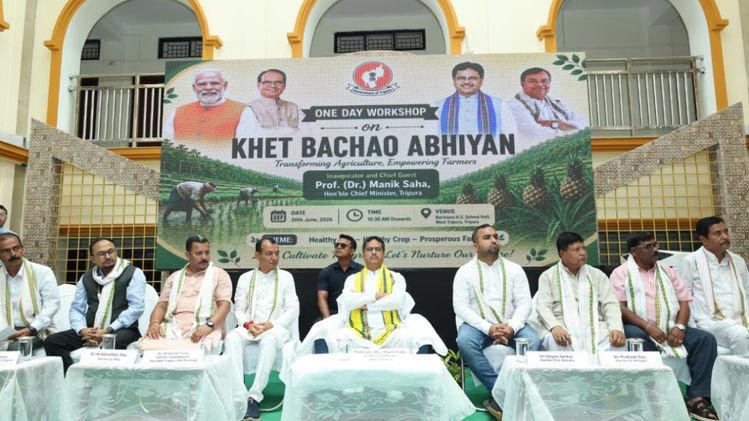
Tripura Chief Minister Manik Saha has launched the ‘Save the Field Campaign’, a statewide initiative aimed at promoting sustainable organic farming, improving soil health, and encouraging environmentally responsible agricultural practices. The campaign seeks to reduce the excessive use of chemical fertilizers and pesticides while motivating farmers to adopt eco-friendly cultivation methods that enhance productivity and preserve natural resources.
The initiative reflects the state government’s growing emphasis on sustainable agriculture as a key pillar of rural development and food security. By combining scientific farming techniques with traditional agricultural knowledge, the campaign aims to create a healthier agricultural ecosystem that benefits farmers, consumers, and the environment alike.
Officials believe that the programme will strengthen Tripura’s position as a leader in organic agriculture while creating long-term economic opportunities for farming communities across the state.
Promoting Sustainable Agriculture
The ‘Save the Field Campaign’ has been designed to encourage farmers to embrace sustainable farming practices that maintain soil fertility and protect biodiversity. The government has emphasized that healthy agricultural land is essential for ensuring food security and improving the long-term productivity of farms.
Through awareness programmes, demonstrations, and farmer outreach activities, the campaign seeks to educate cultivators about the benefits of balanced nutrient management, organic manure, crop rotation, natural pest control, and efficient water use.
Officials noted that sustainable farming not only improves agricultural output but also reduces environmental degradation caused by excessive dependence on chemical inputs.
The campaign is expected to create greater awareness about responsible farming practices among both experienced farmers and younger agricultural entrepreneurs.
Focus on Organic Farming
Organic farming forms the central theme of the campaign. Tripura has increasingly promoted organic cultivation due to its favorable agro-climatic conditions and growing consumer demand for chemical-free agricultural products.
The government plans to encourage farmers to gradually transition from conventional farming methods to organic production by providing technical guidance, training programmes, and institutional support.
Agricultural experts participating in the campaign will demonstrate methods of preparing organic compost, bio-fertilizers, vermicompost, and natural pest management solutions that reduce reliance on synthetic chemicals.
Officials believe that expanding organic farming can enhance product quality while opening new opportunities in premium domestic and export markets.
Improving Soil Health
One of the campaign’s primary objectives is to restore and maintain soil health, which has become an increasingly important issue in modern agriculture.
Excessive use of chemical fertilizers and pesticides over extended periods can reduce soil fertility, affect microbial activity, and lower long-term agricultural productivity.
The ‘Save the Field Campaign’ promotes balanced nutrient application, regular soil testing, organic matter enrichment, and scientific soil management practices to improve fertility and sustainability.
Healthy soils not only produce better crops but also retain water more effectively, reduce erosion, and contribute to climate resilience.
Officials stressed that preserving soil health is essential for ensuring agricultural productivity for future generations.
Empowering Farmers Through Training
Farmer education remains a key component of the campaign. The Agriculture Department plans to organize workshops, field demonstrations, training camps, and awareness drives across different districts of Tripura.
Experts will provide practical guidance on sustainable cultivation techniques, integrated pest management, efficient irrigation systems, and climate-resilient farming methods.
The programme also encourages knowledge-sharing between agricultural scientists and experienced farmers who have successfully adopted organic farming practices.
By improving technical knowledge and farming skills, the campaign aims to enhance both productivity and profitability.
Officials expect that continuous capacity-building initiatives will encourage wider adoption of environmentally responsible agriculture.
Reducing Dependence on Chemical Inputs
The campaign seeks to gradually reduce the excessive use of chemical fertilizers, pesticides, and herbicides by promoting natural alternatives.
Balanced nutrient management and organic farming methods help minimize production costs while reducing environmental pollution and protecting beneficial insects and microorganisms.
Officials believe that limiting excessive chemical usage will improve food safety, protect groundwater quality, and preserve ecological balance.
Natural farming techniques also support biodiversity by encouraging healthier ecosystems within agricultural landscapes.
The campaign highlights that sustainable farming practices benefit not only farmers but also consumers and future generations.
Strengthening Rural Economy
Agriculture remains one of the most important sources of livelihood in Tripura. The government believes that sustainable farming can significantly contribute to rural economic development by improving crop quality and expanding market opportunities.
Organic produce often commands higher market prices, creating additional income opportunities for farmers.
The campaign also supports the development of value-added agricultural products, farmer producer organizations, and cooperative marketing systems that strengthen rural enterprises.
Officials expect that improved agricultural sustainability will generate employment across cultivation, processing, packaging, transportation, and marketing sectors.
The initiative aligns with broader efforts to create resilient and self-reliant rural economies.
Supporting Environmental Conservation
Environmental sustainability is another major objective of the ‘Save the Field Campaign.’ Sustainable farming practices contribute to reduced soil erosion, improved water conservation, enhanced biodiversity, and lower greenhouse gas emissions.
The campaign encourages tree plantation around agricultural fields, efficient irrigation techniques, rainwater harvesting, and conservation of natural resources.
Officials noted that climate change has increased the importance of adopting environmentally responsible farming systems capable of withstanding changing weather patterns.
By integrating agriculture with environmental conservation, the campaign seeks to create long-term ecological resilience throughout Tripura.
Government’s Long-Term Agricultural Vision
The launch of the campaign reflects Tripura’s broader vision of developing a sustainable and competitive agricultural sector.
The government continues to invest in agricultural infrastructure, farmer training, irrigation projects, horticulture development, digital agriculture, and market connectivity.
Future plans include expanding organic certification programmes, strengthening research, improving post-harvest management, and encouraging private investment in agro-processing industries.
Officials believe that integrating sustainable farming with technological innovation will enhance productivity while protecting natural resources.
The campaign forms an important part of the state’s long-term agricultural transformation strategy.
Encouraging Community Participation
The success of the ‘Save the Field Campaign’ depends largely on active participation from farmers, local communities, educational institutions, agricultural organizations, and self-help groups.
The government has appealed to citizens to support sustainable agriculture by promoting awareness, adopting environmentally responsible practices, and encouraging local consumption of organic products.
Community-based participation is expected to strengthen the campaign while fostering greater environmental responsibility among rural populations.
Officials emphasized that sustainable agriculture requires collective action involving farmers, scientists, policymakers, and consumers alike.
Conclusion
The launch of the ‘Save the Field Campaign’ by Chief Minister Manik Saha marks an important step in Tripura’s efforts to promote sustainable organic farming and environmentally responsible agricultural development. By focusing on soil health, farmer education, reduced chemical dependency, and organic cultivation, the initiative aims to create a more resilient agricultural sector capable of meeting future challenges.
As Tripura continues to strengthen its position in organic agriculture, the campaign is expected to improve farmers’ livelihoods, enhance food quality, conserve natural resources, and support long-term rural development. Through sustained government support and active community participation, the ‘Save the Field Campaign’ has the potential to become a model for sustainable agricultural transformation in the region.