

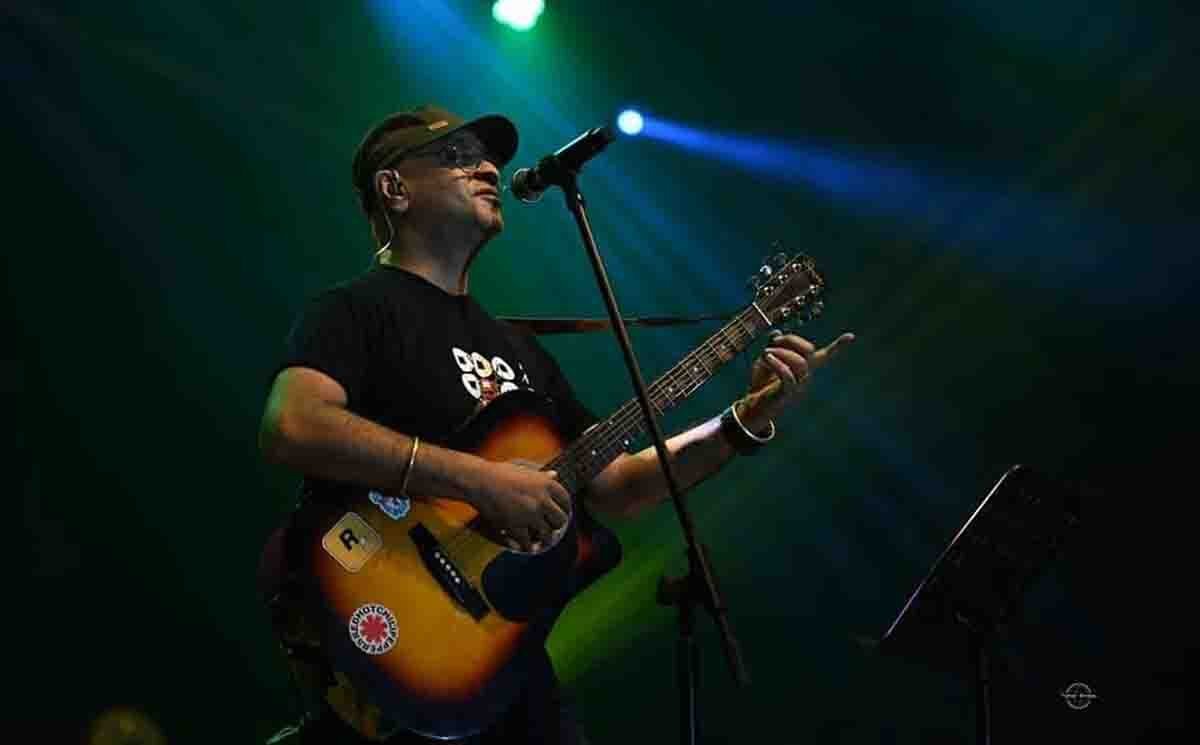
Assamese musician Joi Barua has taken part in an international performing-arts initiative that connects music, science, animation and space exploration. The Joi Barua cosmic project includes music inspired by stellar evolution, quantum physics and the origins of elements in the universe.
Barua has composed and co-composed music for the wider Cosmic Rhapsody and LIM Trilogy projects. The work later developed a thematic connection with NASA’s Compton Spectrometer and Imager (COSI) mission.
However, Cosmic Rhapsody is not a NASA production. Instead, its creators found a strong scientific connection with COSI after visiting the Space Sciences Laboratory at the University of California, Berkeley.
Guwahati Flyover Project Reaches Major Milestone in Traffic Decongestion
Joi Barua Cosmic Project Connects Music and Space Science
The Joi Barua cosmic project grew from a collaboration between Barua and physician-scientist and storyteller Dr Susan Lim. Their professional relationship began at an INK Conference in Singapore, where Barua performed and Lim attended as a speaker.
Lim later shared lyrics for The ALAN Song with Barua and asked him to compose the music. That collaboration became the beginning of a wider artistic journey that eventually developed into the LIM Trilogy and Cosmic Rhapsody.
Barua subsequently composed melodies for Star Among the Cosmic Clouds and Confetti Storm. He also co-composed Confetti Star-Ion with French composer and orchestrator Manu Martin.
The songs form part of a larger narrative built around stars, stardust and the emergence of new worlds. Consequently, the music combines scientific themes with storytelling rather than presenting astronomy as a purely technical subject.
The project also involves Assamese artist Samudra Kajal Saikia, who contributes animation and visual storytelling. His involvement adds another Northeast Indian creative voice to the international production.
Together, the artists are working within a production that explores space, artificial intelligence, planetary renewal and humanity’s relationship with the cosmos.
NASA COSI Mission Adds a Scientific Connection
The Joi Barua cosmic project gained its NASA connection after the creative team visited UC Berkeley’s Space Sciences Laboratory in December 2025. The visit took place during the North American premiere of LIM Fantasy of Companionship for Piano and Orchestra.
During the visit, the team discussed the project’s themes with scientists and leadership at the laboratory. They identified similarities between the story’s treatment of stellar evolution and the scientific objectives of NASA’s upcoming COSI mission.
COSI stands for Compton Spectrometer and Imager. The mission is designed to study soft gamma rays produced by powerful cosmic events. Its research will help scientists investigate the formation of elements through processes associated with exploding stars.
That connection gave the artistic project a new scientific dimension. The creators could relate their fictional and musical treatment of stellar evolution to an active astrophysics mission.
However, the distinction remains important. Cosmic Rhapsody did not originate as a NASA production, and NASA did not commission Barua’s music for the project. Instead, the connection emerged because both the artistic work and COSI explore related ideas surrounding stars, elements and cosmic evolution.
NASA itself has also used sound to make astronomical data more accessible. Its data-sonification programme converts information from telescopes and space observations into frequencies that people can hear. Such work demonstrates how sound can provide another way to experience astronomical data.
The COSI connection therefore places Barua’s music within a broader conversation between scientific research and the performing arts.
Teleportation Brings Assamese Music to Abbey Road
The Joi Barua cosmic project expanded further with the worldwide release of Teleportation [Unbound] on October 2, 2026. The Assamese-language track connects quantum physics, space travel and human relationships through an orchestral musical narrative.
Barua co-composed the song with Manu Martin. Dr Susan Lim conceived and wrote the lyrics, while Christina Teenz Tan also contributed to the writing. The track explores the idea of quantum entanglement as a creative metaphor for connection across great distances.
The recording also involved a 70-piece orchestra at Abbey Road Studios in London. The Royal Philharmonic Orchestra performed the orchestral score at Studio One.
Two versions of Teleportation [Unbound] were released. British vocalist Tom Ball performs the international edition, while Barua provides the vocals for the Indian and subcontinental edition.
Additionally, Samudra Kajal Saikia created the conceptual artwork and visual world associated with the single. His contribution continues the collaboration between Assamese artists and the wider international creative team.
The release timing also carries significance. It arrived just before World Space Week 2026, which runs from October 4 to 10. This year’s theme is “Rocket Revolution,” focusing attention on space exploration and its wider impact.
Therefore, the Assamese release gives Barua’s involvement a new public dimension. His voice and musical identity remain connected to the project even as the production operates across international artistic and scientific settings.
Assamese Heritage Finds a Global Cosmic Platform
The Joi Barua cosmic project represents another stage in the musician’s long career of combining Assamese influences with contemporary musical forms. Barua was born in Digboi and received a violin from his father at the age of four.
His musical influences developed across several traditions. Assamese folk music and the work of Bhupen Hazarika existed alongside international artists and Western popular music in his musical background. He later moved through Shillong, Guwahati and Mumbai before establishing himself as a singer, composer and performer.
Barua’s work has also reached major international recording and performance spaces. His earlier ALAN-related work included recording with the London Symphony Orchestra at Abbey Road. He also became the first Assamese composer to have works performed by the Royal Philharmonic Orchestra, according to India Today.
Meanwhile, his contribution to Cosmic Rhapsody brings an Assamese creative perspective into a project built around universal themes. Stars, space, artificial intelligence and planetary survival may appear distant from regional musical traditions. Yet the project places those themes within a distinctly human artistic framework.
That combination is particularly relevant to the project’s international character. Rather than presenting science and culture as separate areas, the production uses music, animation and storytelling to explore scientific ideas.
Furthermore, Barua’s involvement demonstrates how regional artists can participate in international productions without abandoning their cultural identity. His Assamese-language work on Teleportation [Unbound] provides a direct connection between the project’s global themes and his own linguistic and musical background.
The project is also expected to reach a major live audience. Cosmic Rhapsody is scheduled to premiere at the Hollywood Bowl on July 27, 2027, with the Los Angeles Philharmonic and pianist Jean-Yves Thibaudet. The planned performance will take place ahead of NASA’s expected COSI launch from Cape Canaveral.
Consequently, Barua’s participation has developed from a collaboration between individual artists into a broader international production linking music, visual art, science and space.
Conclusion
The Joi Barua cosmic project has placed an Assamese musician at the centre of an international creative production inspired by stellar evolution, quantum physics and humanity’s relationship with space. Barua has composed music for key songs within the Cosmic Rhapsody project and has expanded the collaboration through the Assamese track Teleportation [Unbound].
The project has a thematic connection with NASA’s COSI mission, but it is important to distinguish that relationship from a formal NASA production. The connection developed after the creative team visited UC Berkeley’s Space Sciences Laboratory and recognised parallels between the project’s story and COSI’s scientific objectives.
Meanwhile, Barua’s Assamese-language contribution and Samudra Kajal Saikia’s visual work bring Northeast India’s creative talent into the international production. The planned 2027 Hollywood Bowl premiere could provide another major platform for the project.
FAQs
What is the Joi Barua cosmic project?
The Joi Barua cosmic project refers to Barua’s involvement in the international Cosmic Rhapsody and related LIM Trilogy productions, which combine music, science, animation and space-themed storytelling.
Is Cosmic Rhapsody a NASA production?
No. Cosmic Rhapsody is an independent performing-arts production. It developed a thematic connection with NASA’s COSI mission after its creators visited the UC Berkeley Space Sciences Laboratory.
What songs did Joi Barua compose?
Barua composed melodies for Star Among the Cosmic Clouds and Confetti Storm. He also co-composed Confetti Star-Ion with Manu Martin.
What is Teleportation [Unbound]?
Teleportation [Unbound] is an Assamese-language track inspired by quantum entanglement, cosmic distances, space travel and human connection. Barua co-composed the song with French composer and orchestrator Manu Martin.
When will Cosmic Rhapsody premiere?
The production is scheduled to premiere at the Hollywood Bowl on July 27, 2027, with the Los Angeles Philharmonic and pianist Jean-Yves Thibaudet.