

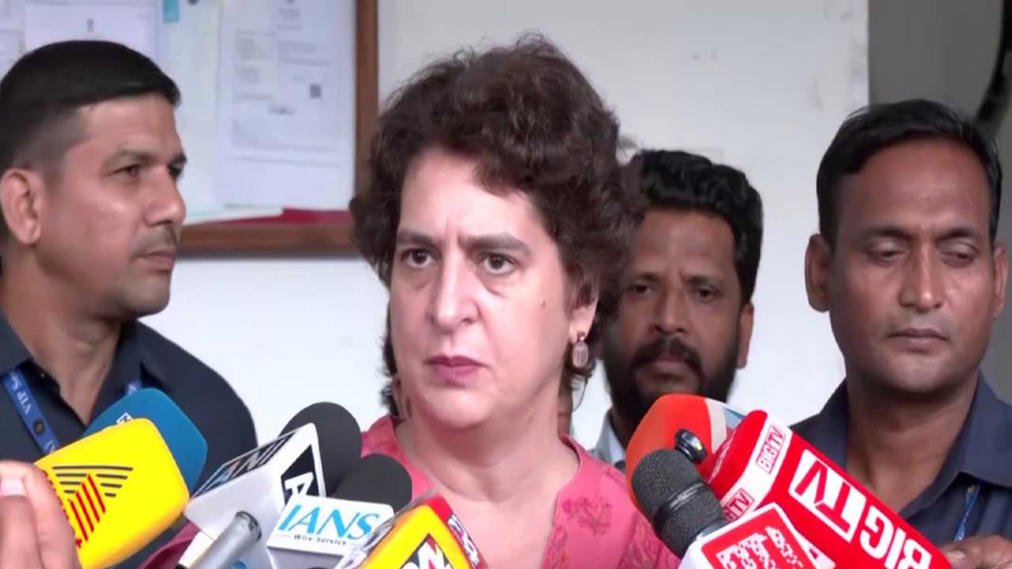
Congress MP Priyanka Gandhi Vadra has called for the criminal prosecution of Chief Election Commissioner Gyanesh Kumar over alleged irregularities in the revision of electoral rolls.
Speaking to reporters in Wayanad on Thursday, Priyanka alleged that the electoral process had been compromised through the deletion and alleged tampering of voter names. She said that if illegal acts were committed, those responsible should face criminal proceedings.
Her remarks came amid a growing political dispute over the Special Intensive Revision (SIR) of electoral rolls and reports of objections raised by two Election Commissioners.
Priyanka also questioned the legal protection available to the Chief Election Commissioner.
Congress Leader Links Issue to SIR
The Congress MP’s comments followed a report by The Indian Express about internal objections within the three-member Election Commission.
According to the report, Election Commissioners Sukhbir Singh Sandhu and Vivek Joshi raised objections on at least 14 occasions over a period of 10 months. The reported objections concerned decisions and orders linked to electoral-roll revision under the SIR process.
The issues reportedly included voter deletions and other aspects of electoral-roll management.
Priyanka said the reported objections made the matter particularly serious. She argued that the Election Commission has a responsibility to protect the integrity of elections.
The claims about the internal objections come from media reports and have become the subject of a wider political debate.
Priyanka Questions Legal Protection
Priyanka also questioned why the CEC should receive legal protection if an investigation establishes that illegal acts were committed.
She argued that officials who knowingly participate in unlawful actions should be subject to the same legal process as others.
The Congress MP said that any deliberate interference with the democratic process would require legal action. She also used the term “treason” while describing what she alleged would be the consequences of deliberately allowing an unfair election.
Her comments represent the Congress position. They do not establish that the CEC committed a criminal offence.
Allegation of Large-Scale Voter Deletion
Priyanka referred to the deletion of around 13 crore voters from electoral rolls.
She described the alleged deletion as a serious issue for democracy and the Constitution. She also alleged that the CEC knew about concerns raised by other Election Commissioners but allowed the process to continue.
The figure and allegations have been cited by opposition leaders in the current political debate. However, electoral-roll revision involves different stages, categories and states, and the Election Commission has not accepted the characterisation that 13 crore eligible voters were simply removed from the electorate.
In West Bengal, for example, the Election Commission recently told the Supreme Court that 27.16 lakh voters were removed during the SIR process. More than 22 lakh of those voters had filed appeals seeking reinstatement.
This distinction is important when discussing national claims about voter deletions.
Election Commission Defends Its Process
The Election Commission has rejected suggestions that its decision-making process was divided.
According to reports, the Commission has maintained that decisions relating to the SIR were approved unanimously by the three members.
The reported objections by individual commissioners, according to the Commission’s position, were part of internal deliberations and do not demonstrate that the final decisions lacked institutional approval.
The Commission has therefore disputed the interpretation that the reports indicate a breakdown within the constitutional body.
Three-Member Commission at Centre of Debate
The controversy has also highlighted the structure of the Election Commission.
The Commission currently consists of the CEC and two Election Commissioners. Article 324 of the Constitution establishes the Election Commission and gives it responsibility for the superintendence, direction and control of elections.
The law governing the Commission provides for collective decision-making. It also allows decisions to be taken by majority when members do not agree.
The reported objections have therefore prompted questions about how internal disagreements were handled during the SIR process.
Electoral Rolls Face Wider Scrutiny
Electoral-roll revision has become a major issue across several states.
The SIR process involves checking voter information and identifying entries that may require correction, verification or deletion. It can also allow eligible citizens to seek inclusion or restoration of their names.
In West Bengal, the Election Commission told the Supreme Court that 22.21 lakh appeals sought inclusion and another 16.10 lakh sought further deletions. The Commission said the appeals followed the SIR process in the state.
The scale of the appeals has added to the debate over the speed and transparency of the process.
Supreme Court Examines SIR-Related Issues
The judiciary has also examined aspects of the electoral-roll revision process.
In Delhi, the Supreme Court has sought explanations from the Election Commission regarding notices issued to voters under the category of “logical discrepancies”. The court’s intervention reflects ongoing scrutiny of how electoral-roll verification is conducted.
The judicial proceedings are separate from the political allegations made by opposition leaders.
Any finding of unlawful conduct would depend on evidence and the outcome of the relevant legal processes.
Opposition Intensifies Attack on CEC
Priyanka Gandhi’s statement is part of a broader opposition campaign against the functioning of the Election Commission.
Other opposition leaders have also criticised Gyanesh Kumar over the SIR process. West Bengal Chief Minister Mamata Banerjee separately demanded the arrest and criminal prosecution of the CEC and called for fresh elections based on pre-SIR electoral rolls in states where the BJP won.
These demands reflect the opposition’s political position on the electoral-roll controversy.
The BJP and the Election Commission have disputed the allegations.
Debate Over Institutional Accountability
The controversy has raised broader questions about accountability within constitutional institutions.
The Election Commission has extensive responsibilities. It supervises electoral rolls and conducts elections to Parliament, state legislatures and the offices of the President and Vice-President.
Questions about voter registration and deletion therefore have significant public importance.
At the same time, allegations against constitutional officials require evidence and due process before criminal liability can be established.
Priyanka’s demand for prosecution is therefore a political call for legal action. It is not a judicial finding against the CEC.
Political and Legal Debate Continues
Priyanka Gandhi’s latest remarks have intensified the dispute over electoral-roll revision and the functioning of the Election Commission.
She has argued that any official who knowingly allows illegal manipulation of electoral rolls should face criminal prosecution. She has also questioned the legal protections available to the CEC.
The Election Commission, meanwhile, maintains that its decisions were taken by the full three-member body and that the reported differences form part of internal deliberations.
With SIR-related issues also before the Supreme Court, the debate now involves political, administrative and legal dimensions.
Further proceedings and official findings will determine whether the allegations raised against the electoral-roll process have any legal consequences.