

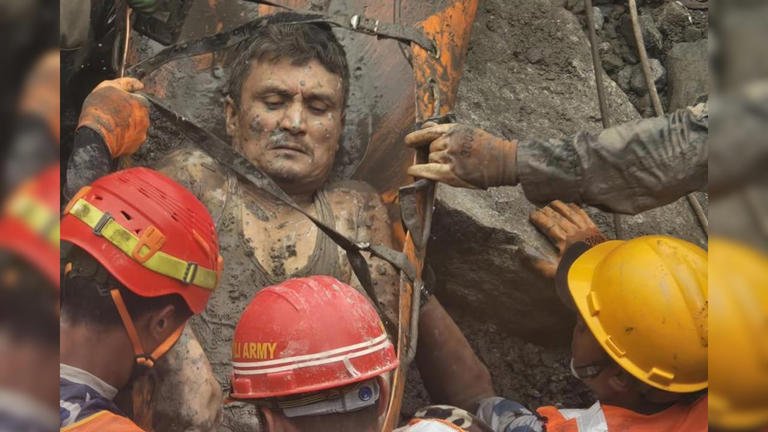
For nine days, Sanjay Sah and Kabir Maharjan remained trapped underground inside a blocked hydropower tunnel in Nepal. Cut off from the outside world after devastating floods swept through the region, the two men survived against overwhelming odds.
Rescuers finally pulled them out alive from the tunnel of the Trishuli 3A Hydropower Project on September 4. Their rescue brought a rare moment of hope to Nepal, where a massive disaster had left thousands dead or missing.
The two workers had been trapped since August 26, when a devastating flood of water, mud and debris swept through the region and severely damaged hydropower projects.
Sah, 30, worked as a mechanical foreman, while Maharjan, 45, served as a mechanical supervisor. Rescuers found them about 170 metres inside the flooded and debris-filled tunnel. Both men had injuries, but they survived the extraordinary nine-day ordeal.
Their rescue has also renewed hopes that other people trapped inside Nepal’s damaged tunnel network may still be alive.
Two Men Trapped After Nepal Flood Disaster
The disaster struck Nepal’s Himalayan region on August 26.
A devastating surge of water, rock, mud and debris swept through river valleys and caused widespread destruction. The disaster severely affected several hydropower projects, including the Trishuli 3A Hydropower Project.
Workers inside and around the project faced immediate danger as floodwaters and debris entered the area.
Sanjay Sah was working at the project when the disaster struck. Kabir Maharjan was also at the hydropower facility.
The two men eventually became trapped deep inside the underground tunnel system.
The tunnel’s entrance became blocked by debris, leaving them cut off from rescue teams outside.
For days, there was little certainty about whether anyone inside could still be alive.
The scale of the wider disaster made the rescue operation even more difficult. Floodwaters, mud and damaged infrastructure created dangerous conditions for emergency teams attempting to reach the trapped workers.
Despite these challenges, Nepal Army personnel and other rescue teams continued searching.
Sanjay Sah Stayed Behind to Help Others Escape
Sanjay Sah’s actions during the initial moments of the disaster added another remarkable dimension to the rescue story.
Sah reportedly delayed his own escape because he wanted to help his colleagues get out safely.
He was working as a mechanical foreman at the Trishuli 3A Hydropower Project when the flood struck.
Rather than immediately fleeing, Sah first tried to help others escape the danger.
However, the rapidly changing conditions left him trapped inside the tunnel.
His decision to remain behind ultimately placed him among those cut off underground after floodwaters and debris blocked the route out.
For the next nine days, Sah remained inside the tunnel without knowing when or whether rescuers would reach him.
His survival and eventual rescue became one of the most extraordinary developments to emerge from the disaster.
Kabir Maharjan Also Remained Cut Off Underground
Kabir Maharjan faced a similar battle for survival inside the blocked tunnel.
Maharjan, a mechanical supervisor at the hydropower project, became trapped after the disaster disrupted access to the underground structures.
The two men had entered the crisis from different circumstances, but they eventually found themselves facing the same terrifying reality.
They were completely cut off from the outside world.
For more than a week, their families and colleagues had little information about their condition.
As rescue teams worked through difficult conditions, hopes of finding survivors naturally began to fade.
However, the two men continued to survive underground.
Their eventual discovery shocked and encouraged both rescuers and families waiting for news.
Reports said Maharjan was conscious when rescuers brought him out of the tunnel. Both men received medical attention after the rescue.
Their survival demonstrated the extraordinary role that determination, shelter and conditions inside the tunnel may have played during the nine-day ordeal.
Air Pockets May Have Helped Them Survive
One of the biggest questions following the rescue was how the two men managed to survive for nine days underground.
Reports suggested that air pockets inside the deeper sections of the tunnel may have played a crucial role.
A stable pocket of breathable air could have allowed the trapped workers to remain alive despite being surrounded by mud, debris and flood-damaged structures.
The underground tunnel also contained trapped water, which may have contributed to their ability to survive for such a long period.
The conditions were still extremely dangerous.
The men reportedly suffered injuries to their hands and legs, possibly after crawling through mud-filled passages inside the tunnel.
Yet they managed to survive until rescue teams finally reached them.
Their survival has given rescuers fresh hope that similar air pockets may exist elsewhere inside the tunnel system.
This possibility has become important as search teams continue looking for other missing workers.
Rescuers Heard Voices From Inside the Tunnel
The breakthrough in the operation came when rescuers detected signs that people inside the tunnel could still be alive.
Rescue teams reportedly heard voices from within the blocked underground area.
This discovery changed the direction and urgency of the operation.
The teams worked to establish communication with those trapped and continued efforts to reach them through the debris.
Nepal Army personnel, along with other security forces and technical teams, worked under difficult and dangerous conditions.
The rescue operation required patience and careful planning because unstable debris and damaged tunnel structures could create further risks.
Teams worked continuously to clear access routes and locate possible survivors.
Eventually, they reached Sanjay Sah and Kabir Maharjan deep inside the tunnel.
The moment they emerged alive became an emotional breakthrough after nine days of uncertainty.
Images from the rescue showed emergency personnel carrying the mud-covered survivors out of the underground structure.
For a disaster-hit nation searching for thousands of missing people, the rescue offered a powerful moment of hope.
Survivors Receive Medical Treatment
After their rescue, both Sah and Maharjan received immediate medical attention.
The men had spent nine days inside extremely difficult conditions and required urgent assessment and treatment.
Reports indicated that both had injuries to their hands and legs.
The prolonged period underground also raised concerns about oxygen deprivation, exhaustion and other health complications.
Sah and Maharjan were taken for medical care after rescuers brought them out.
Their rescue remained remarkable because the men had survived in a dark, damaged and isolated underground environment for more than a week.
Their physical condition and recovery will continue to receive close attention.
For their families, the rescue brought an end to days of fear and uncertainty.
For the wider rescue operation, their survival provided important information about the conditions that may exist inside other blocked sections of the tunnel.
Rescue Raises Hope for Other Missing Workers
The successful rescue of Sah and Maharjan has renewed hopes that other trapped workers may still be alive.
Large numbers of workers remain missing following the destruction of hydropower projects during the disaster.
Several people are believed to have been trapped inside tunnels and underground structures.
Rescue teams are now paying close attention to possible air pockets and other spaces where survivors may have found shelter.
The fact that two men survived for nine days demonstrates that rescue teams cannot assume that the passage of time has eliminated all hope.
Emergency teams continue to search damaged tunnel networks and clear blocked entrances.
The operation remains extremely challenging.
Rescuers must deal with mud, unstable debris and damaged infrastructure while avoiding actions that could further endanger people trapped underground.
However, the discovery of Sah and Maharjan has given the operation new momentum.
Their survival has become evidence that extraordinary circumstances can sometimes produce extraordinary outcomes.
Nine Days Underground and a Remarkable Return
The story of Sanjay Sah and Kabir Maharjan is now one of the most remarkable survival stories to emerge from Nepal’s devastating flood disaster.
For nine days, the two men remained trapped inside a blocked hydropower tunnel with little connection to the world outside.
Sah had stayed behind to help colleagues escape. Maharjan also found himself trapped deep underground as the disaster transformed the hydropower project into a dangerous maze of mud and debris.
Their survival depended on extraordinary circumstances.
Breathable air pockets, trapped water and their own determination may have helped them endure until rescuers reached them.
When emergency teams finally found them around 170 metres inside the tunnel, the operation delivered a rare moment of joy amid widespread tragedy.
The rescue of the two men has also brought renewed hope for other families still waiting for news.
As search operations continue across Nepal’s damaged hydropower sites, the story of Sah and Maharjan serves as a powerful reminder that hope can survive even in the darkest and most isolated places.
For nine days, they remained hidden beneath mud, debris and darkness.
On the ninth day, they came back alive.